I said in Part I of this review that I had one disagreement with Dr. Arnold and that he had changed my thinking about one aspect of the sexuality debate in a way that I don’t think he intended.
Is the biblical debate really settled?
My disagreement with Arnold is about the state of the biblical debate. I’ll summarize his presentation first, then explain my disagreement.
Citing Christopher Seitz, Arnold says that we “have seen three separate and distinct phases in the church’s understanding of Scripture [on the issue of homosexuality]” in the past forty years.
He describes phase one as a time for reevaluating biblical passages on same-sex practices. Perhaps these passages had been misunderstood and misread. Maybe they didn’t condemn ordinary same-sex practices. Maybe these were addressing particular problems in particular cultures.
He describes phase two as a time when people realized the phase one arguments didn’t work. They accepted that “[t]he Bible really is consistently negative toward same-sex practices.” Instead, people in this phase pointed to things like the Jerusalem Council of Acts 15 as a model. If those church leaders could agree to accept Gentiles as converts without requiring circumcision, why couldn’t we make a similar move now regarding same-sex practices?
Finally, Arnold describes phase three––our current reality––as a time when people see the Bible as irrelevant on this issue. It isn’t able to take into account the newer development of “monogamous faithful homosexuality.” In this phase, supporters of same-sex intimacy simply regard the Bible as “a book of religious development, from one Testament to the next” [quoting Seitz]. But we’ve gotten past those points of development in our “enlightened modern times.”
Because of this, Seeing Black and White approaches the discussion about homosexuality as if the biblical debate is already settled. Arnold confirmed as much in our interview: “the church isn’t listening to the scriptural evidence anyway.” As a result, he focuses on showing why we should heed the scriptural evidence. He largely assumes that we already have agreement about what the scriptural evidence shows––an unqualified condemnation of homosexual practice.
From the discussions I’m hearing, I’m not sure this is an accurate read of the current climate. I see a lot of discussions that Arnold would call “phase one.”
I see a lot of people suggesting that the few mentions of homosexuality in the Bible were about particular problems in those cultures. Several people have asked me if Paul’s references to homosexuality weren’t just as culturally specific as his references to women wearing head-coverings in worship.
I wouldn’t give the book to anyone having those conversations and asking those questions. I think it starts by assuming answers to questions they’re still asking.
To be fair, Arnold doesn’t neglect this discussion entirely. He has an excellent example, showing Old Testament and New Testament writers at a roundtable discussing ethics. While many topics show progress and “deeper formulations” in the movement from earlier to later writings, the discussion of same-sex practices has a flatline consensus around the table. For my friends who aren’t yet convinced about the biblical position, they’ll need to see a lot more like that discussion.
For what it’s worth, I agree with Arnold’s position that the Bible is consistently negative toward same-sex practices. I just don’t agree with him that everyone else is convinced of that.
As he said in the interview, there are already some great resources that deal with this. Arnold cites Richard Hays’s excellent essay on Homosexuality in The Moral Vision of the New Testament along with Robert Gagnon’s The Bible and Homosexual Practice and Richard Davidson’s Flame of Yahweh. His roundtable example recalls William Webb’s argument in Slaves, Women & Homosexuals.
It may be too much to ask one little book to rehash all those arguments and advance the discussion. Just know that Arnold’s work can’t stand on its own. It stands on the conclusions already made in these resources.
For anyone who doesn’t come to the book already agreeing that “the Scripture clearly condemns same-sex practices,” I think it would be better to start with one of the resources linked above. If those convince you, then move on to Seeing Black and White.
How Seeing Black and White changed my mind in a different way than intended
In our interview, I shared this quote from the book: “[I]t can be argued that the church failed to influence culture in the 1960s, losing its voice and failing to condemn nonmarital sexual practices of all kinds.”
That quote has continued to ring in my head. The United Methodist Church’s statement on human sexuality says, “sexual relations are affirmed only with the covenant of monogamous, heterosexual marriage.”
Dr. Arnold has convinced me that conservative leaders in the UMC have no right to a voice on homosexuality until they demonstrate a consistent voice on heterosexual sex. Among our leaders, ministry candidates, and ordained clergy, I suspect that most violations of our standards for human sexuality are heterosexual, not homosexual. Are we taking these as seriously?
If your church’s standards for membership, leadership, or employment treat homosexual and heterosexual indiscretions differently, you’re not taking a stand for holiness, you’re discriminating.
Until your Board of Ordained Ministry will just as quickly ask and remove someone from candidacy for having sex with his girlfriend as for having sex with his boyfriend, you have no justification for your position. This is to address only our beliefs on human sexuality. Perhaps we could go further, but we must go at least this far.
Maybe I’m wrong about this and we’re already taking seriously all issues of sexuality. But I’ve seen enough to believe that we have a double standard that turns a blind eye to many heterosexual indiscretions while railing against any hint of homosexual practice. This is indefensible.
If this is true, I think we’re fighting the wrong fight. We need to get back to a serious stance on heterosexual sexuality first, or we need to give up the whole sexuality debate at once. To fight for a hard-line stance on homosexual practice after we’ve given up that stance on heterosexual sex is hypocritical. We have no right to be taken seriously so long as we’re double-minded on this.
Perhaps Dr. Arnold would agree with all of this. If so, I would have loved to see more ink spilled on our “heterosexual problem.” But this may be again asking one small book to do more than it should have to do.
I’d love to hear your thoughts and questions. Though I’ve listed two issues here that I would have liked to read more about, as Part I of this review showed, I eagerly recommend this book to most people. Check it out at the Seedbed publisher website.
I should start this review by saying I’m no neutral observer. Dr. Arnold has been a long-time encourager, supporter, mentor and friend to me. I have great respect for him. And on the particular focus of this book––theological reasoning about sexuality and how the United Methodist Church should handle it––my beliefs largely agree with Bill’s.
Given those biases, my long list of praise for this book won’t surprise you, though I hope the things I list would be beneficial to most people, regardless of their biases. I’ll share four things I thought were especially excellent in the review below.
While most of what I have to say about the book is positive, I do have one disagreement with Dr. Arnold. He also changed my thinking about one aspect of this issue in a way that I don’t think he wanted to. I’ll explain both of those points in a post to follow (NOW AVAILABLE HERE).
What I love about Seeing Black and White
For a small book (204 pages) and an easy read, this book is packed with information.
I expect most people would tell you Seeing Black and White is about homosexuality and the United Methodist Church. But I would eagerly give it to several people who aren’t in the UMC and have no interest in the debate over homosexuality. That’s because I think the book is an education in many other important areas. You’ll see that only my fourth point directly applies to the church’s debate over sexuality.
1 – A healthy approach to theological conversation
I belong to a group whose motto is, “People we respect; ideas we beat within an inch of their lives.” I think Seeing Black and White is a shining example of those values.
In a debate that has involved no small amount of name-calling and personal attacks, I think Arnold gives a great demonstration of grace and truth––toward both Hamilton and all other interested and affected parties.
Arnold’s approach is an education in logic––a pleasant surprise to me. He uses the word “fallacy” 29 times. He explains and identifies the Ad Populum Fallacy, the Red Herring Fallacy, the Ad Baculum Fallacy, the False Cause Fallacy, and the Fallacy of False Dilemma, to name a few. If you don’t know what these are, you will after reading, and you’ll be equipped to analyze others’ arguments with greater acumen and ease.
2 – Taking on pragmatism
I’ve been dismayed by the Western Church’s focus on pragmatism. We often seem more persuaded by what works than what’s faithful (though all of us hope for situations where both are true).
I was excited to see Arnold fighting back against pragmatism. He writes,
Adam’s book is firmly rooted in pragmatism. By this I mean decisions about controversial issues are often based on claims about what works or what is believed to be most effective in appealing to the greatest number of people […] The question needs to be raised: Is it legitimate to establish Christian practice along the lines of a business model in which measurable or numerical success determines truth?
In an atmosphere where numerical success receives more attention and accolades than anything, Arnold provides a needed corrective. He also demonstrates that while the world may want a church that acts as a mirror, “reflecting the values of the world back upon itself,” the world has no need for that kind of church. He provides a much richer version of the church––the kind that will continue to be relevant in our world precisely because it doesn’t mirror the world’s values back to itself.
3 – How to read the Bible
I would love to give several friends chapter 3, “The Fork in the Road.” It could stand on its own as a clear and concise essay on “reading the Bible the Wesleyan way,” as Arnold calls it.
In this, Arnold confronts popular ways of reading the Bible and shows their flawed logic. For example, he addresses the common idea that Jesus’ words carry more weight than the rest of the Bible––and even that Jesus’ silence on certain issues carries more weight than anything the rest of the Bible says. So he writes, “Jesus also didn’t mention genocide or rape. To argue that his silence on these topics means he approves them is of course nonsense.”
Arnold instead offers three principles of biblical interpretation that we would do well to keep in mind.
In the first, he explains understanding texts in context––arguing against proof-texting specific verses but also against dismissing certain texts as irrelevant. I hear plenty of people today cautioning against proof-texting. I don’t hear enough cautioning us not to dismiss texts that prohibit lobster-eating and beard-trimming. Arnold’s insights here are important.
The second principle teaches a different understanding of the Bible’s purpose than I usually see. Arnold writes, “As sacred canon for the church, we believe the Bible is not primarily inspired for us to know things (epistemology),” instead its primary function in and for the church is “to know God through personal and corporate salvation (soteriology).” This point could change the life of anyone who hasn’t grasped it yet. The primary function of the Bible is to cultivate a life-giving relationship, not to help us win a trivia contest.
The third principle focuses on the primacy of Scripture. Arnold is concerned (and for good reason, I think) that many have neglected this principle, especially in ethical debates. He presents a healthy model for understanding the “Wesleyan Quadrilateral” in light of its many abuses today.
4 – Framing the debate about homosexuality
I think Arnold provides an exemplary framework for the debate about homosexuality, even for those who disagree with his conclusions.
In chapter 3, he describes without bias the general positions of the two “camps” in this debate––naming them the “Holiness” and “Hospitality” camps (an improvement on the titles I previously used: “Holiness” and “Openness”). In chapter 5, he shows why we make a category mistake to pit these two against each other.
The sixth chapter is another that could stand alone as an excellent essay. In it, Arnold deconstructs three common myths about the debate: that it’s about orientation, liberation, or civil rights. The discussion of sexual orientation is more researched and nuanced than what we typically hear in the public discourse. The discussion about liberation is a profound critique of “sexual liberation” in all its forms. The discussion about civil rights provides a historical understanding of civil rights movements and why this debate doesn’t fit.
These are only a few highlights. As I write this review, I’m again made aware of how many high points this book has. I’ll let this review serve simply as a small sampler, and I’ll urge you to go buy the book.
I’ll leave you with this great quote that serves as a nice summary of Dr. Arnold’s constructive proposal for moving forward:
Unlike Adam, I believe the holistic gospel we need today is not something to be created in the twenty-first century by Christians who are able to discern gray. I believe it emerged in the late eighteenth century in the Wesleyan revival, whose leaders scrutinized afresh the black-and-white truths of Scripture in the context of ancient church tradition. And I believe the holistic gospel they preached continues to offer the world the best understanding of Christianity’s apostolic faith.
Bill Arnold, Professor of Old Testament Interpretation at Asbury Theological Seminary
What should the church teach and practice regarding homosexuality? Our debates have been escalating for decades and have reached a fever pitch. Several denominations have already split because of their disagreements. The United Methodist Church is threatening to be next.
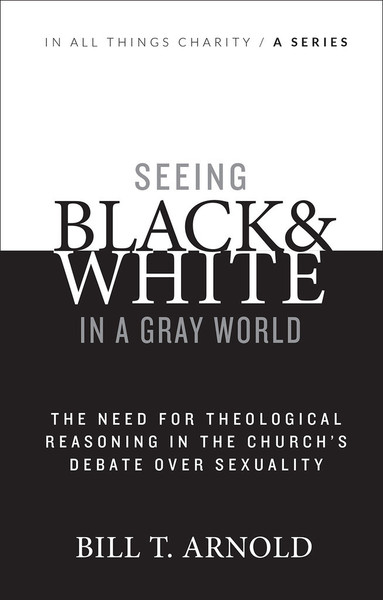
Among other things, the book serves as an extended response to Adam Hamilton’s 2008 book, Seeing Gray in a World of Black and White: Thoughts on Religion, Morality, and Politics. Hamilton’s view has been championed as the “middle way,” the agree-to-disagree view, the gray area between polarized black-and-white camps. Arnold argues that no such middle way is possible in this case (or in many of the other cases Hamilton discusses).
I’ll share my review of the book next week (NOW AVAILABLE HERE). But for now, Dr. Arnold has allowed me the privilege to interview him about his book, the church’s debate about homosexuality, and the future of the United Methodist Church.
Thanks for your time, Dr. Arnold.
On the surface, this is an unusual book. It’s a book-length review of something that came out six years ago. It’s an Old Testament professor writing about modern theology and ethics. So why did you think this book was needed in the first place? Why choose Adam Hamilton’s book as your “conversation partner”? And why is an Old Testament professor writing this kind of book at all?
While the book engages Adam’s, I prefer to see it as a collegial discussion over coffee. We happen to disagree. As I explain in the Preface, I only read his book in 2012, on my way to General Conference in Tampa. But I also hope my readers will see the book as more than an extended review. In reality, the first two chapters attempt to critique and deconstruct what Adam has proposed. Then in chapters 3-6, I reconstruct a different way of looking at the debate in the church over human sexuality. These are chapters in which I hope to offer something original and genuinely helpful to the church, rather than merely interacting with Adam’s proposals.
I chose Adam as a “conversation partner” frankly because he is so influential in our church. Most of what he has accomplished is laudable. I celebrate the way God has used him in his ministry, and continues to use him. But I also believe that because of his success, our church has not thought critically enough about his proposals related to same-sex practices.
And, Yes, I’m an Old Testament teacher. One reviewer said it was odd that an OT scholar/professor should engage in dialogue with a pastoral theologian, and another friend has privately scolded me for coming down out of the “ivory tower” to address “real life” problems I don’t understand. I find this whole thing interesting. We academics get slammed for being “ivory tower” and not writing or speaking about things people care about. Then when we do, we get slammed for writing or speaking about things people care about. I admit in the book that I stepped significantly out of my comfort zone to write this book. I often imagine what it would have been like to stay in my world of Hebrew exegesis and the book of Deuteronomy. Safer, to be sure. But the story I tell in the preface about my experience at General Conference 2012 emboldened me to step into the public arena, to clear my throat, to express my views. I think of my interaction with Adam as a mutual engagement of ideas, an exchange of differing opinions, and the power and value of that engagement lies in the ideas and truths expressed, regardless of the source.
Have you talked directly with Adam Hamilton about the disagreements you list in the book—either before or since its writing? How have those conversations gone?
Yes. I had met him a few times, but we had never talked about these issues. As I say, I was not fully aware of his views until I read his book in April 2012. And to answer your question more fully, I need to explain the process I went through to write the book. I had the ideas, basic outline, and general plan for the book on the airplane back from Tampa. I wrote the first chapter that fall, but then I placed the book aside. I frankly didn’t want to continue it. Gradually, during the Spring Semester, 2013, I felt convicted that I should return to the manuscript and keep writing. So during the summer, I placed aside several other writing projects, which I still consider to be my primary calling, in order to write this book for the church. All along the way, I argued with myself (or with God) about whether or not I was really going to publish this.
Once I came to realize that yes, indeed, I was really going to offer this for publication, then I contacted Adam. I explained to him what I was planning, and we engaged in an email discussion. I wish it could have been more substantive and in person. But this was the best we could do. You asked how the conversations have gone. I suppose they have gone as you might expect. We are simply not going to agree on this issue, even if we are together on many other issues. We’re always collegial and gentlemanly, if that’s what you mean. In some ways, I hope we can model how Christians can disagree, and do it in a Christian manner.
Your approach surprised me. I expected a biblical studies person to do a deep-dive into some of the biblical passages on homosexuality. Instead, your book taught me a lot about logical fallacies (I counted 29 uses of the word fallacy), theological method, and myths in the contemporary ethical debate. Why’d you choose this approach?
I suppose it’s about the needs I perceived in the church. We have several extensive treatments of the biblical data related to same-sex practices. I especially benefitted from Richard Hays, Robert Gagnon, William Webb, Richard M. Davidson, and others. I also took the opportunity to engage the counter arguments represented in the works of Sylvia Keesmaat and Luke Timothy Johnson, although my critiques of their work will not appear until this fall in another publication. The point is, I didn’t need to rehash all that work. Besides, the church isn’t listening to the scriptural evidence anyway. I spent quite a lot of time on hermeneutical method and explaining why scripture is important. But in general, the church needs to be reminded today, in my opinion, about “theological reasoning” as I say in the subtitle.
You say, “We don’t need a newly reformed Christianity. We need instead a Methodism that is renewed and empowered to continue the social work of spreading scriptural holiness across the land, as the early Methodists did.” Could you say more? What’s the difference between “reformed” and “renewed”? And what does the UMC lack for the kind of renewal and empowerment you mention?
That quote comes from a larger critique of Adam’s approach, which proposes a new generation of Christians of the middle-way should combine parts of both extremes (Falwell or Spong) into a new Christianity. He believes this reformed Christianity will be created by people who see more gray than black-&-white. This call for a new reformation borrows a theme from the Emerging Church, which I think is trendy and already waning in influence. I think this call for a new reformation is overreaching, and what we really need is renewal of what we have in Wesleyan theology. A fresh proclamation of our theology is what the world needs. I really believe that. But we’re distracted and torn apart by conflict. We need renewal and empowerment, not new answers to controversial debates.
You argue that there is no middle way on the issue of same-sex practices. It’s a fork in the road. Either we approve them, or we don’t. But some people will say we don’t have to force everyone down the same path. We don’t require all of our pastors to remain in lock-step on our beliefs about creation, or our stance on tobacco use, for instance. So why enforce conformity on this issue?
Our statement on sexuality emphasizes the sacred worth of all persons, and is clear that we do not condemn individuals for experiencing same-sex attraction. The pressure on our church today is on the specific questions of ordination and the nature of Christian marriage. And how these relate to same-sex practices presents the church with the single most important social issue of our day.
The pressure to address the question would not be as great for congregationalist denominations. They have mechanisms for letting each congregation decide. But Methodism defines itself as connectional, and sees this as one of the most important ways we participate in the one, catholic, universal church. Of course, we don’t all agree on every issue. But as a connectional church, our Social Principles offer the world our best theological thinking on every aspect of life in the modern world. How can this not include official statements embraced by the connection on human sexuality?
You had a great section at the end of the book, debunking myths in the current debate. This quote stood out to me:
“The church’s teaching about sex is not the problem, and liberation from that teaching has not provided healthy freedom. On the contrary, it can be argued that the church failed to influence culture in the 1960s, losing its voice and failing to condemn nonmarital sexual practices of all kinds.”
You suggest that the church lost its voice on sexual issues fifty years ago. Might it be hard for people to respect a stance on same-sex intimacy from a church that has, as you say, “failed to condemn nonmarital sexual practices of all kinds”? Have we lost the right to speak on sexuality? Or are we starting in the wrong place by making same-sex practices our focus?
Yes, in one sense we are starting in the wrong place. We’re here because North American culture is driving the UMC quickly toward becoming another example of “cultural Christianity” rather than biblical Christianity.
That quote is part of a discussion of the “myth of liberation” in the current debate. My point is that the church lost the battle during the sexual revolution of the 1960s, in which “liberation” was a central theme. And once the church lost its influence in the culture, we simply grew quiet on sexual promiscuity generally, whether we’re talking about multiple marriages without just cause for divorce or premarital cohabitation. The church has grown silent on those topics and is now unfortunately fixated on same-sex practices. But you’re right, the church exists to teach the world and offer the world a higher way, a more excellent ethic that is ultimately satisfying to God and more fulfilling as human beings in this created order. The church extends grace and care to persons experiencing same-sex attraction. It’s vitally important that the church find new and creative ways to do that. But we also offer everyone in the church, no matter our sexual experiences or preferences, a way of holy living that ultimately fits our souls for communion with God.
Two of the most prominent violations of the UMC stance on same-sex marriages involve UM pastors who officiated the weddings of their gay sons. I’m sure situations like that would cause someone to do a lot of soul-searching. If you’ll indulge a hypothetical—a gay son comes to you and says, “Dad, I’m getting married. I hope you’ll be at the wedding. I’d really like you to officiate it.” What do you say?
Great question. As I say in the preface to the book, I had long talks with two of my three sons about this topic while I was writing the book. (Our youngest son was on deployment with the Marine Corps in Afghanistan at the time.) They were helpful chats because they don’t all agree with everything I’ve said here. But this is something that never came up. I think and hope my first impulse would be to assure him how much I love him, and how much I will never allow anything to break our relationship. I think my sons know me well enough, have gone through enough with me to know, I would probably grab him and hug him first, and then start talking about it. Of course the next part of my answer is hypothetical, so I can only say this is what I hope I would do. But I hope I would say I would attend the ceremony, and express my unhesitating love for my son, but that I could not perform the ceremony. I think any of my sons would understand this. A wedding ceremony is God’s stamp of approval, acknowledging that God honors and blesses, and approves of love between two people, and finally, that God approves the sexualization of that relationship. When I perform wedding ceremonies, I’m an instrument of God’s grace to approve and bless that union. I would hope my son would love and respect me enough to understand my position, and welcome my presence in attendance at the ceremony, but accept my decision not to perform the ceremony. That would be incredibly difficult and painful. I don’t want to minimize the pain others have gone through in making this decision. But just as they say it’s a question of pastoral integrity that leads them to perform same-sex wedding ceremonies, I respond that indeed, it’s integrity that drives me to say I simply cannot perform them. I think my sons would understand that.
A lot of different proposals are coming out right now regarding the impasse in the UMC. Another group just recently issued a press release through Good News Magazine that essentially said it’s time to acknowledge our differences and work toward an amicable split. If you had to propose or endorse a way forward for the UMC, what would you say right now? To get more realistic, what do you think is most likely for our future?
Well, those are two different questions. Because I’m basically a pessimist, I need to say I don’t have much hope for keeping us together. But I’m also not part of those groups calling for a split or amicable separation. I prefer staying together as a denomination, but finding ways to hold bishops and annual conferences accountable to the “sacred trust,” as the Book of Discipline says, that binds us together. We’re in this mess because some have chosen deliberately to break faith with the connection, which they consider biblical disobedience. I consider it schismatic.
I also don’t favor proposals circulating just now that favor allowing the local congregation to decide the question of marriage/civil unions, and annual conferences’ Boards of Ordained Ministries to decide the question of ordination. I don’t support those proposals for two main reasons. First, on the authority of the local church to decide the question of marriage/unions, I believe this would make us congregationalists. Our connectionalism is one of the hallmarks of Methodism, which also locates us squarely in the one, catholic, universal Church. The idea of turning to local congregations to settle this important and sensitive issue reconfigures Methodism significantly. Second, on the ordination question, I cannot image the confusion and chaos created at the conference level. I make no claim to be an expert on the appointment system. But this strikes me as “everyone doing what is right in their own eyes” chaos (you might have expected an Old Testament allusion).
And just for fun… You’ve been a delegate to the past two General Conferences. You were the second person nominated in the Kentucky Conference last time, and the person who was nominated before you is now a bishop. If nominated for the episcopacy, will you run? If elected, will you serve?

 I said in Part I of this review that I had one disagreement with Dr. Arnold and that he had changed my thinking about one aspect of the sexuality debate in a way that I don’t think he intended.
 teddy ray