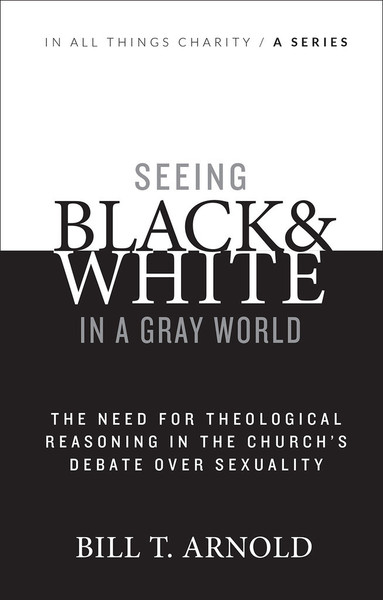
Why Seeing Black and White is Needed (maybe more needed than Bill Arnold thinks) [pt. II]

Two weeks ago, I interviewed Bill Arnold about his new book, Seeing Black and White in a Gray World: The Need for Theological Reasoning in the Church’s Debate Over SexualityGo to that interview to see more summary of the book and Dr. Arnold’s thoughts about it.

Last week, I shared Part I of this review, with four things I love about Seeing Black and White.

This part concludes my review.
seeing black whiteI said in Part I of this review that I had one disagreement with Dr. Arnold and that he had changed my thinking about one aspect of the sexuality debate in a way that I don’t think he intended.

Is the biblical debate really settled?

My disagreement with Arnold is about the state of the biblical debate. I’ll summarize his presentation first, then explain my disagreement.

Citing Christopher Seitz, Arnold says that we “have seen three separate and distinct phases in the church’s understanding of Scripture [on the issue of homosexuality]” in the past forty years.

He describes phase one as a time for reevaluating biblical passages on same-sex practices. Perhaps these passages had been misunderstood and misread. Maybe they didn’t condemn ordinary same-sex practices. Maybe these were addressing particular problems in particular cultures.

He describes phase two as a time when people realized the phase one arguments didn’t work. They accepted that “[t]he Bible really is consistently negative toward same-sex practices.” Instead, people in this phase pointed to things like the Jerusalem Council of Acts 15 as a model. If those church leaders could agree to accept Gentiles as converts without requiring circumcision, why couldn’t we make a similar move now regarding same-sex practices?

Finally, Arnold describes phase three––our current reality––as a time when people see the Bible as irrelevant on this issue. It isn’t able to take into account the newer development of “monogamous faithful homosexuality.” In this phase, supporters of same-sex intimacy simply regard the Bible as “a book of religious development, from one Testament to the next” [quoting Seitz]. But we’ve gotten past those points of development in our “enlightened modern times.”

Because of this, Seeing Black and White approaches the discussion about homosexuality as if the biblical debate is already settled. Arnold confirmed as much in our interview: “the church isn’t listening to the scriptural evidence anyway.” As a result, he focuses on showing why we should heed the scriptural evidence. He largely assumes that we already have agreement about what the scriptural evidence shows––an unqualified condemnation of homosexual practice.

From the discussions I’m hearing, I’m not sure this is an accurate read of the current climate. I see a lot of discussions that Arnold would call “phase one.”

I see a lot of people suggesting that the few mentions of homosexuality in the Bible were about particular problems in those cultures. Several people have asked me if Paul’s references to homosexuality weren’t just as culturally specific as his references to women wearing head-coverings in worship.

I wouldn’t give the book to anyone having those conversations and asking those questions. I think it starts by assuming answers to questions they’re still asking.

To be fair, Arnold doesn’t neglect this discussion entirely. He has an excellent example, showing Old Testament and New Testament writers at a roundtable discussing ethics. While many topics show progress and “deeper formulations” in the movement from earlier to later writings, the discussion of same-sex practices has a flatline consensus around the table. For my friends who aren’t yet convinced about the biblical position, they’ll need to see a lot more like that discussion.

For what it’s worth, I agree with Arnold’s position that the Bible is consistently negative toward same-sex practices. I just don’t agree with him that everyone else is convinced of that.

As he said in the interview, there are already some great resources that deal with this. Arnold cites Richard Hays’s excellent essay on Homosexuality in The Moral Vision of the New Testament along with Robert Gagnon’s The Bible and Homosexual Practice and Richard Davidson’s Flame of Yahweh. His roundtable example recalls William Webb’s argument in Slaves, Women & Homosexuals.

It may be too much to ask one little book to rehash all those arguments and advance the discussion. Just know that Arnold’s work can’t stand on its own. It stands on the conclusions already made in these resources.

For anyone who doesn’t come to the book already agreeing that “the Scripture clearly condemns same-sex practices,” I think it would be better to start with one of the resources linked above. If those convince you, then move on to Seeing Black and White.

How Seeing Black and White changed my mind in a different way than intended

In our interview, I shared this quote from the book: “[I]t can be argued that the church failed to influence culture in the 1960s, losing its voice and failing to condemn nonmarital sexual practices of all kinds.”

That quote has continued to ring in my head. The United Methodist Church’s statement on human sexuality says, “sexual relations are affirmed only with the covenant of monogamous, heterosexual marriage.”

Dr. Arnold has convinced me that conservative leaders in the UMC have no right to a voice on homosexuality until they demonstrate a consistent voice on heterosexual sex. Among our leaders, ministry candidates, and ordained clergy, I suspect that most violations of our standards for human sexuality are heterosexual, not homosexual. Are we taking these as seriously?

If your church’s standards for membership, leadership, or employment treat homosexual and heterosexual indiscretions differently, you’re not taking a stand for holiness, you’re discriminating.

Until your Board of Ordained Ministry will just as quickly ask and remove someone from candidacy for having sex with his girlfriend as for having sex with his boyfriend, you have no justification for your position. This is to address only our beliefs on human sexuality. Perhaps we could go further, but we must go at least this far.

Maybe I’m wrong about this and we’re already taking seriously all issues of sexuality. But I’ve seen enough to believe that we have a double standard that turns a blind eye to many heterosexual indiscretions while railing against any hint of homosexual practice. This is indefensible.

If this is true, I think we’re fighting the wrong fight. We need to get back to a serious stance on heterosexual sexuality first, or we need to give up the whole sexuality debate at once. To fight for a hard-line stance on homosexual practice after we’ve given up that stance on heterosexual sex is hypocritical. We have no right to be taken seriously so long as we’re double-minded on this.

Perhaps Dr. Arnold would agree with all of this. If so, I would have loved to see more ink spilled on our “heterosexual problem.” But this may be again asking one small book to do more than it should have to do.

I’d love to hear your thoughts and questions. Though I’ve listed two issues here that I would have liked to read more about, as Part I of this review showed, I eagerly recommend this book to most people. Check it out at the Seedbed publisher website.

Did you enjoy this? Don’t miss the next post. Sign up to receive free updates.

Why Seeing Black and White is Needed (maybe more needed than Bill Arnold thinks) [pt. I]

seeing black whiteLast week, I interviewed Bill Arnold about his new book, Seeing Black and White in a Gray World: The Need for Theological Reasoning in the Church’s Debate Over SexualityI’ll let you go there to see more summary of the book and Dr. Arnold’s thoughts about it.

I should start this review by saying I’m no neutral observer. Dr. Arnold has been a long-time encourager, supporter, mentor and friend to me. I have great respect for him. And on the particular focus of this book––theological reasoning about sexuality and how the United Methodist Church should handle it––my beliefs largely agree with Bill’s.

Given those biases, my long list of praise for this book won’t surprise you, though I hope the things I list would be beneficial to most people, regardless of their biases. I’ll share four things I thought were especially excellent in the review below.

While most of what I have to say about the book is positive, I do have one disagreement with Dr. Arnold. He also changed my thinking about one aspect of this issue in a way that I don’t think he wanted to. I’ll explain both of those points in a post to follow (NOW AVAILABLE HERE).

What I love about Seeing Black and White

For a small book (204 pages) and an easy read, this book is packed with information.

I expect most people would tell you Seeing Black and White is about homosexuality and the United Methodist Church. But I would eagerly give it to several people who aren’t in the UMC and have no interest in the debate over homosexuality. That’s because I think the book is an education in many other important areas. You’ll see that only my fourth point directly applies to the church’s debate over sexuality.

1 – A healthy approach to theological conversation

I belong to a group whose motto is, “People we respect; ideas we beat within an inch of their lives.” I think Seeing Black and White is a shining example of those values.

The book offers a lengthy critique of Adam Hamilton’s Seeing Gray in a World of Black and White. While Arnold beats many of Hamilton’s ideas within an inch of their lives, he also shows respect for Hamilton throughout. You can see more examples of that in the first two questions of our interview.

In a debate that has involved no small amount of name-calling and personal attacks, I think Arnold gives a great demonstration of grace and truth––toward both Hamilton and all other interested and affected parties.

Arnold’s approach is an education in logic––a pleasant surprise to me. He uses the word “fallacy” 29 times. He explains and identifies the Ad Populum Fallacy, the Red Herring Fallacy, the Ad Baculum Fallacy, the False Cause Fallacy, and the Fallacy of False Dilemma, to name a few. If you don’t know what these are, you will after reading, and you’ll be equipped to analyze others’ arguments with greater acumen and ease.

2 – Taking on pragmatism

I’ve been dismayed by the Western Church’s focus on pragmatism. We often seem more persuaded by what works than what’s faithful (though all of us hope for situations where both are true).

I was excited to see Arnold fighting back against pragmatism. He writes,

Adam’s book is firmly rooted in pragmatism. By this I mean decisions about controversial issues are often based on claims about what works or what is believed to be most effective in appealing to the greatest number of people […] The question needs to be raised: Is it legitimate to establish Christian practice along the lines of a business model in which measurable or numerical success determines truth?

In an atmosphere where numerical success receives more attention and accolades than anything, Arnold provides a needed corrective. He also demonstrates that while the world may want a church that acts as a mirror, “reflecting the values of the world back upon itself,” the world has no need for that kind of church. He provides a much richer version of the church––the kind that will continue to be relevant in our world precisely because it doesn’t mirror the world’s values back to itself.

3 – How to read the Bible

I would love to give several friends chapter 3, “The Fork in the Road.” It could stand on its own as a clear and concise essay on “reading the Bible the Wesleyan way,” as Arnold calls it.

In this, Arnold confronts popular ways of reading the Bible and shows their flawed logic. For example, he addresses the common idea that Jesus’ words carry more weight than the rest of the Bible––and even that Jesus’ silence on certain issues carries more weight than anything the rest of the Bible says. So he writes, “Jesus also didn’t mention genocide or rape. To argue that his silence on these topics means he approves them is of course nonsense.”

Arnold instead offers three principles of biblical interpretation that we would do well to keep in mind.

In the first, he explains understanding texts in context––arguing against proof-texting specific verses but also against dismissing certain texts as irrelevant. I hear plenty of people today cautioning against proof-texting. I don’t hear enough cautioning us not to dismiss texts that prohibit lobster-eating and beard-trimming. Arnold’s insights here are important.

The second principle teaches a different understanding of the Bible’s purpose than I usually see. Arnold writes, “As sacred canon for the church, we believe the Bible is not primarily inspired for us to know things (epistemology),” instead its primary function in and for the church is “to know God through personal and corporate salvation (soteriology).” This point could change the life of anyone who hasn’t grasped it yet. The primary function of the Bible is to cultivate a life-giving relationship, not to help us win a trivia contest.

The third principle focuses on the primacy of Scripture. Arnold is concerned (and for good reason, I think) that many have neglected this principle, especially in ethical debates. He presents a healthy model for understanding the “Wesleyan Quadrilateral” in light of its many abuses today.

4 – Framing the debate about homosexuality

I think Arnold provides an exemplary framework for the debate about homosexuality, even for those who disagree with his conclusions.

In chapter 3, he describes without bias the general positions of the two “camps” in this debate––naming them the “Holiness” and “Hospitality” camps (an improvement on the titles I previously used: “Holiness” and “Openness”). In chapter 5, he shows why we make a category mistake to pit these two against each other.

The sixth chapter is another that could stand alone as an excellent essay. In it, Arnold deconstructs three common myths about the debate: that it’s about orientation, liberation, or civil rights. The discussion of sexual orientation is more researched and nuanced than what we typically hear in the public discourse. The discussion about liberation is a profound critique of “sexual liberation” in all its forms. The discussion about civil rights provides a historical understanding of civil rights movements and why this debate doesn’t fit.


These are only a few highlights. As I write this review, I’m again made aware of how many high points this book has. I’ll let this review serve simply as a small sampler, and I’ll urge you to go buy the book.

I’ll leave you with this great quote that serves as a nice summary of Dr. Arnold’s constructive proposal for moving forward:

Unlike Adam, I believe the holistic gospel we need today is not something to be created in the twenty-first century by Christians who are able to discern gray. I believe it emerged in the late eighteenth century in the Wesleyan revival, whose leaders scrutinized afresh the black-and-white truths of Scripture in the context of ancient church tradition. And I believe the holistic gospel they preached continues to offer the world the best understanding of Christianity’s apostolic faith.

See part II of my review here.

———————

What I’m reading, brief book reviews, and your questions for an interview

As you well know, I’m a bit of a bibliophile. (Oh––you’ve been looking for the perfect gift for me? Yes, that Amazon gift card is a great idea! My birthday is in November.) A few things in that regard…

1 – On the side-panel of my webpage, I’ve added two new sections: “What I’m Reading” and “What I Just Read.” I love hearing about what others are reading, and several people ask me about this, so I thought I’d use this forum to share. I always keep three books in my reading rotation, so each section will have my latest three.

The “What I Just Read” gives a 50-word review of those books to help you decide if you might be interested in one of them. Feel free to email me with questions about these. Fifty words doesn’t go too far.

seeing black white2 – I’ll be interviewing Bill Arnold in a couple weeks about his new book, Seeing Black and White in a Gray World: The Need for Theological Reasoning in the Church’s Debate Over Sexuality.

I think this is a timely and important book. Arnold engages throughout with the teaching and writing of Adam Hamilton, the most prominent pastor in the UMC. As far as I know, it’s also the only book-length proposal for the UMC’s stance and practice regarding homosexuality, the most important social issue of our day.

If you have any questions you would ask Dr. Arnold, I’d love to hear them. You can email them to me.


[Note: All book links are Amazon affiliate links. Buy wherever you choose.]