
“Keeping the lights on” vs “Giving to missions”

lights on

lights onIt’s a lot more fun to give to missions than giving to keep the lights on. I hear that a lot in my position.

And I get it. It really is more fun to think about all the great work being done by [fill in your favorite outreach center / missions agency] than to think about paying the church’s utility bills.

But do you know what almost every outreach center / missions agency has to do when they receive that money? They pay to keep their lights on.

Is there a better way to think about our giving? Can we acknowledge that all those mundane things – like keeping lights on – are an important part of the extraordinary ministry happening in any setting?

Perhaps we shouldn’t be so quick to ask whether we want to pay to keep lights on or to pay for something that sounds more glamorous. I wonder if I’ve ever been a bit selfish in wanting my giving to go only to the actual work – not to mundane things like lights and administration. It’s as if I thought, “Someone else’s money can pay for the mundane, I want to feel like my giving went to something special.” And at that point, it’s really about me, isn’t it?

We’re well-intentioned in this, please don’t get me wrong. But do you think we’ve taken an approach that isn’t really fair or best?

Is the charitable organization you’re giving to being wise and faithful with money? Do you believe in their mission? Do you believe in their faithfulness to that mission? Then give generously to them, knowing that part of what they’ll do is pay the utilities bills.

Is the charitable organization you’re giving to being wasteful? Are they choosing luxury and extravagance to the detriment of the mission? Has bureaucracy overtaken mission? You’ve seen some questions I’ve raised about salaries and buildings. Then you should probably talk to them about it or stop giving. I’d strongly recommend talking first. There’s a chance you don’t have the full picture.

If you’re giving to a church, I think it’s important to ask how much that church is giving beyond itself. How much is going purely to provide care and activities for its own? How much is the church actively sending out to support other outreach centers and missions agencies, to support the extended proclamation of the gospel across the world?

I’ve been really proud to see my church trying to take next steps toward this. Just last night, our Council affirmed a decision to immediately send 25% of all giving out the door – 10% to support outreach and missions, 15% to our denomination. We hope to do more, but I’m happy with the movement in this direction.

Where I’ve come to in it all… If I believe a church/center/agency is doing something good, I want to give to them freely. Yes, some of that will go to keeping the lights on. But I’m glad they have the lights on so they can keep doing the extraordinary work they’re doing. I don’t want to hamstring them by requiring my money to go for something extraordinary and telling them to find someone else to keep their lights on.
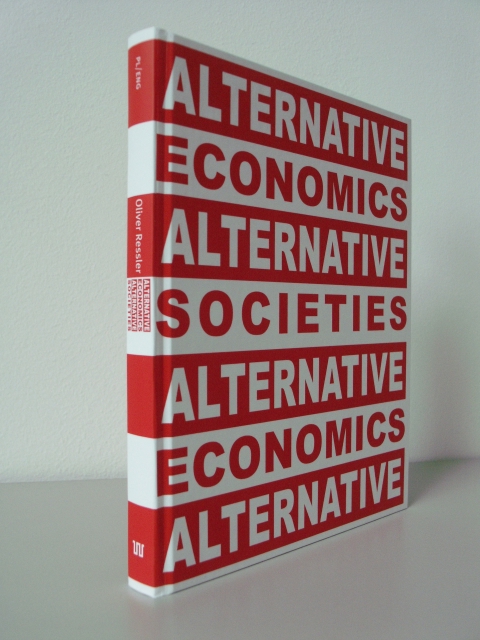
The Church as Alternate Economy

alternate economy

alternate economy* This began as a response to a good comment on The Pastor Salary Fallacy. See comments there for points to the other side.

Let me take a first stab at describing why I speak about the Church and money in ways that sound odd to most people.

The Church as Alternate Society and Alternate Economy

At root, I’m looking for the Church to live as an alternate society (by no means separate from the world, but by all means very distinct from the world), a society that in many ways provides a prophetic critique of the rest of society, a counter-culture. This is some of what I was getting at in the post Prophets and Pragmatism.

And in a culture submerged in capitalism (no, I don’t believe God is a capitalist… or a socialist – see Christians, Capitalism and Ayn Rand and Jesus and Politics), I think one of the most important parts of that alternate society is an alternate economy.

Though maybe our capitalist-immersed setting doesn’t matter. Scripture always seems to describe an alternate economy. One that would have been shocking and rubbed right against the grain of the rest of the world’s economy.

Church Use of Money

So when we consider the Church’s use of money, at best I hope our use of money will be a prophetic critique of the marketplace. At worst, I hope it will ignore the marketplace. Whatever we do, I hope our use of money won’t be overly influenced by the marketplace. Can we re-imagine how money would be handled in a new creation economy without being terribly influenced by the capitalist US marketplace?

For instance – why are we concerned to be sure our high-level people have enough for comfortable retirement, a nice house in a good school district with nice vacations, but we don’t seem nearly so concerned for the same with our custodians and secretaries? I get why the capitalist marketplace differentiates these, but why the Church? What does this reflect about a new creation, Christian economy? We usually say something about “fair,” but what’s our standard for fair? Is the standard “fair market value”? And here we are again, back at capitalist economics in the Church…

This is just something early to try and identify the issue at root in our differences. I need to spend more time thinking and writing on this. Perhaps it will help me realize the fallacy of my own thinking. Perhaps it will convert someone else to my position. (Then there will be four in the world!) Most likely, we’ll all just keep talking in different directions. But at least we’re all trying and talking.

And an important note: this is hard and requires plenty of discerning and questioning. “Do not steal” is usually pretty easy. We can generally draw an easy line with “Do not commit adultery.” On issues of how to live out an alternate economy in the Church, the answers aren’t nearly so clean. I don’t presume to have them all, or to be doing it all even close to right. But regardless, I think they’re important questions to ask and attempt to answer with our lives.

For now, some links to those who have been most influential for me in all of this: William T Cavanaugh, James KA Smith, and John Wesley.

The Pastor Salary Fallacy

preach for food

preach for foodMany people promote a common half-truth about pastors’ salaries, and it needs to end.

I just heard it again last week. “Hey, I only make $50,000.” Well, that was true. Technically.

What it neglected was the $20,000 housing allowance this pastor receives. And the $4,000 utilities allowance.

The truth about pastoral compensation

Pastors’ compensation packages are arranged differently than most. Whereas almost everyone else in America is responsible for paying for their own housing and utilities, these expenses are usually covered for pastors. We usually receive either a parsonage (a house provided by the church) or a housing allowance that covers the cost of our mortgage, along with any furnishings, maintenance, and renovation. And then the church pays for our utilities. This will often include the cost for lawn care, and probably some other things I’m forgetting.

One other benefit: Housing and utilities allowance are exempt from federal income tax. And pastors still get to claim a deduction for the mortgage interest they pay. It’s a double dip, and I have no idea why the IRS allows it, but they do.

Those in parsonages will tell you that they get a bum deal sometimes. They get a house that’s far from ideal and poorly maintained. This is a reality for many, and a genuine concern. Church – if you provide a parsonage for your pastor that you would never consider living in, you need to do something. Then again, you’d be surprised at the quality of some other parsonages. I’ve seen them valued up to $600,000 (in an area where median is $158k).

In all, here’s what this means: The pastor I reference above who only makes $50,000 actually receives $74,000. And $24,000 of that isn’t subject to income tax. Which makes his relative compensation – when compared with people in other professions – roughly $88,000.**

Yes, the IRS allows this – although I expect that to be challenged sometime in the next few decades. But let’s stop telling half-truths about pastors’ salaries.

Pastors, please don’t tell people, “I [only] make $XX,XXX,” and leave out that all costs associated with your housing are taken care of on the side. The people you’re talking to have to use their salaries to pay for their rent/mortgage, their utilities, their home maintenance, their lawn care, their cable bill…

As I read over this, I know it could be taken in a bitter or antagonistic tone. That’s not my intention. I receive a housing allowance and utilities allowance, too. I’m just imploring us to be more honest when we talk and think about our compensation. The lowest compensation package for a United Methodist elder in Kentucky (where median household income is $42,000) is just shy of $60,000. As compensation goes, none of us have anything to complain about.

Thinking theologically about pastoral compensation

My greater hope is that we would stop thinking about pastoral compensation in the business-world pragmatic sense and start thinking theologically about compensation in the church. See this earlier piece: “Pastors’ Salaries and Church Buildings.”

The pragmatists will say we can’t do it or we’ll lose our most talented people. There are a number of problems with that, which I might try to address another time.

For now, I would venture this with the pragmatists in my Methodist tradition. When we look at the relative compensation of our pastors and the numerical growth of Methodism, I bet you’ll find the greatest growth in the times and places where relative compensation was the lowest. And I bet there’s a pretty surprising negative correlation (i.e. one number goes up while the other goes down) between those two numbers over the last 200 years. I’d love to run some numbers on this, but I feel pretty confident about it based on what I’ve seen.

—————–

** Some more details, for those who are really interested…

Because the pastor I reference was a UMC pastor, he has a pretty nice health insurance package, for which his church pays nearly $13,000 annually. They’re also required to make an annual $11,000 pension contribution on his behalf, regardless of whether he contributes anything. Ignoring any other expense allowances or continuing ed, this is a $98,000 pay package. I point all this out just so we know the reality for this person who claimed to make “only $50,000.”

One other unusual thing that comes into play for pastors: we file as “self-employed.” Odd, isn’t it? This means the church doesn’t make FICA/SECA payments on our behalf. If the pastor in this example pays SECA taxes, this is a loss of $5,661. Adjust that comparable compensation number back down to $82,339.

But the final unusual piece: pastors can opt-out of Social Security. That’s a great economic boon to them! It’s also highly questionable, as far as I’m concerned. Anyone who opts out has to sign a statement that states,

I certify that I am conscientiously opposed to, or because of my religious principles I am opposed to, the acceptance (for services I perform as a minister, member of religious order not under a vow of poverty, or a Christian Science practitioner) of any public insurance that makes payments in the event of death, disability, old age, or retirement; or that, makes payments toward the cost of, or provides services for, medical care. (Public insurance includes insurance systems established by the Social Security Act.)

“Conscientiously opposed to […] the acceptance of any public insurance.” Hmmm… I see far more opt-outs out of economic convenience than out of troubled conscience.