Escaping Conformity

From Richard Foster’s Freedom of Simplicity (emphasis and formatting mine):

For the Desert Fathers, the flight to the desert was a way of escaping conformity to the world. The world, including the Church, had become so dominated by secular materialism that, for them the only way to witness against it was to withdraw from it.

They were seeking to revive true Christian devotion and simplicity of life by intense renunciation.

Their experience has particular relevance, because modern society is uncomfortably like the world that they attacked so vigorously.

Their world asked, “How can I get more?”

The Desert Fathers asked, “What can I do without?”

Their world asked, “How can I find myself?”

The Desert Fathers asked, “How can I lose myself?”

Their world asked, “How can I win friends and influence people?”

The Desert Fathers asked, “How can I love God?”

Anthony’s Solitude

Anthony, the “father of monks” (A. D. 251-356), was about eighteen years old when he heard the Gospel words, “Go, sell what you possess and give to the poor… and come, follow me” (Matt. 19:21). Going out from the church, he immediately gave away his inherited land, sold all of his possessions, and distributed the proceeds among the poor, saving only enough to care for his sister.

After living at the edge of his village for a time, he retreated into the desert, where for twenty years he lived in complete solitude. In the solitude he was forced to face his false, empty self.

He learned to die to the opinions of others. He came out of a bondage to human beings. Violent and many were the temptations he faced.

Anthony’s Transformation

When he emerged from the solitude of the desert, he was marked with graciousness, love, kindness, endurance, meekness, freedom from anger, and the practice of prayer.

People recognized in him a unique compassion and power.

Many sought him out for spiritual counsel and healing power.

Even the Emperor Constantine sought his advice…

In the final years of his life he retreated again to the solitude of the desert, where he died in his 105th year.

Where are you being forced to face your false, empty self?

How are you learning to die to the opinions of others? (Click here to tweet that)

How are you becoming a person of unique compassion?

Are you asking how you can get more, or what you can do without? How you can make more people happy, or how you can love God?

The desert monks fled from society to escape conformity. I hope that isn’t always necessary. Can you remain in society (and perhaps speak prophetically to it), yet escape conformity?

Further thoughts in the same direction: Crying out to save ourselves
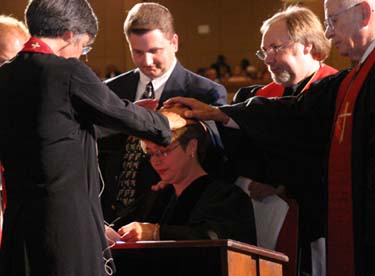
What does ordination mean?

United Methodist clergy are asked 19 historic questions at the beginning of their ordination. A good friend just asked me which of these are binding, and which are simply a nod to our history.

That’s a difficult question to answer when you look at them. I’ve just said that the biggest lie told at every UMC Annual Conference is when ordinands respond to the question, “Will you visit from house to house?” As I look at these other questions, I wonder how many of these we are telling the truth about.

How many pastors recommend fasting or abstinence by both precept and example? How many have avoided massive debt? How many actually approve our church polity and government?

Are any of these still standing but the first: “Have you faith in Christ?”

By winking and grinning at the other 18, are we compromising even the expectation of faith in Christ?

How do you think these historic questions should be used? Binding? Nod to history? Should we consistently evaluate whether clergy are adhering to any/all of these? Which ones?

The historic questions:

  1. Have you faith in Christ?
  2. Are you going on to perfection?
  3. Do you expect to be made perfect in love in this life?
  4. Are you earnestly striving after it?
  5. Are you resolved to devote yourself wholly to God and his work?
  6. Do you know the General Rules of our Church?
  7. Will you keep them?
  8. Have you studied the doctrines of The United Methodist Church?
  9. After full examination, do you believe that our doctrines are in harmony with the Holy Scriptures?
  10. Will you preach and maintain them?
  11. Have you studied our form of Church discipline and polity?
  12. Do you approve our Church government and polity?
  13. Will you support and maintain them?
  14. Will you diligently instruct the children in every place?
  15. Will you visit from house to house?
  16. Will you recommend fasting or abstinence, both by precept and example?
  17. Are you determined to employ all your time in the work of God?
  18. Are you in debt so as to embarrass you in your work?
  19. Will you observe the following directions? a) Be diligent. Never be unemployed. Never be triflingly employed. Never trifle away time; neither spend any more time at any one place than is strictly necessary. b) Be punctual. Do everything exactly at the time. And do not mend our rules, but keep them; not for wrath, but for conscience’ sake.

Subscribe by e-mail to get regular updates on theology, ministry, and life with God.

For more UMC-specific posts, go to my UMC Posts page.

Attracting with buildings…

If you’re expecting to attract new people with your new building upgrade, you can bet that you’re attracting them from some other church. The non-believing world isn’t at home on Sunday because your fellowship hall or children’s wing isn’t nice enough.

If that’s what you’re going for, okay (maybe?). But please don’t suggest that it’s evangelistic.

Or we could offer the gospel!