
Pentecost Confession

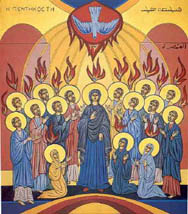
My last post was about letting down our defenses so that we might be open to wounds in worship. The Prayer of Confession in our Pentecost worship this morning was particularly sharp for me. Give yourself some time to reflect on each of these confessions.

Spirit of Truth, we confess that we have not loved one another as you have loved us.

We are quick to find fault and speak ill of others, sins that undermine the fellowship of believers.

We have let strangers and seekers among us feel like outsiders.

We have not done our best to carry the Good News of Jesus Christ beyond the walls of the church.

Forgive our casual disregard of Jesus’ command to go and make disciples.

Forgive us for not using faithfully the powerful gifts of love and service you gave the church at Pentecost.

Renew a right spirit within us, that we may carry the love and mercy of Christ from this place into our weekday community and to the world beyond.

We pray in the name of Christ our Lord, who lives and reigns with you and the Father, one God now and forever. Amen

A word of assurance: In the name of Jesus Christ, you are forgiven.

And our petition in hope: Father, by your Spirit make us one with Christ, one with each other, and one in ministry to all the world, showing forth the fruit of the Spirit until Christ comes in final victory and we feast at his heavenly banquet.

Grace to you and Peace

cropped-momentum2.jpgThe original title for my blog was “Enterprise to Movement.” I fully believe the premise behind that title: that today’s American Church urgently needs to abandon its Enterprise mentality and get back to behaving as a movement. But I abandoned that title after just the first two weeks.

Why I Titled the Blog “Enterprise to Movement”

• We need to get serious again about evangelism. That’s not the same thing as marketing. We need to quit wasting our time and money on ad campaigns designed to convince church-hoppers to come our way and shift that energy to sharing the gospel with people wherever we can.

• The Church needs to reclaim unity and community as more than what the country club down the street means by them. Our aim isn’t a crowd of people smiling at a potluck. That’s easy. And keeps people happy. Our aim is deep relationships in which people’s lives are open to one another. That’s more difficult and much more messy. But I believe it’s our calling if we are a part of the great Christian movement and not just another social club.

• We need to call people to holiness. Holiness is our calling and standard. John Wesley called it “religion itself.” Want messy? Identify sin, call it sin, and urge people to repent. By the grace of God, the Christian movement has seen many sinners who were cut to the heart, repented, and (re)turned to a life of holiness in Christ. We’ve also seen several people who were confronted with their sins and decided they wanted nothing more to do with those calling for change.

I believe that graciously, but firmly, confronting people with their sins is an important part of our faith. But it’s often seen as bad business or bad social club policy, as the short-term results may include less money and fewer people. We also shy away from talking about sin when we misunderstand unity — when we think it means that our highest priority is to avoid offending or upsetting anyone.

Why I Changed the Title

• I’ve heard a lot of testimonies lately. In several of those testimonies, I heard about poor decisions people made. I’m regularly seeing that people made those decisions because they either (a) didn’t know any better – they were behaving the way they had learned to behave, or (b) were hurting, acting in crisis, or in some other way weren’t in a good personal situation to make wise decisions.

• I’ve been reflecting on the beatings church leaders take. I’ve seen several good people get verbally pummeled. Sometimes they had made bad decisions. Sometimes they had made unpopular, but good, decisions. Sometimes they had even made good and popular decisions that just happened to upset the wrong person(s). In all the cases I’m recalling, though, the person being assaulted was a good person with good intentions.

Because of these, I decided to move away from the title “Enterprise to Movement.” I worried that it was setting me up to start from a position of criticism. Yes, I believe that the North American Church is missing the mark considerably — and that the Enterprise mentality has a lot to do with that. But I believe that its leaders are mostly good people who mean well.

Where those leaders are running enterprises — giving more attention to how their worship can attract people than to how it can honor God, letting sin go unabated to avoid offending a large donor or key leader, spending lavishly to outdo the church down the street — I suspect that they’re making those decisions either because our world has taught them to think that way, or because they see a church in crisis and are flailing to do something about it. As my good friend Jonathan says, “No worship planner asks, ‘How can we worship poorly this Sunday?'” I think the large majority of us truly want what is best for the church, even if I also believe that much of our current attitude and focus is misguided.

The apostle Paul begins each of his letters in the New Testament with, “Grace to you and peace.” Many of those letters go on to include strong critiques. But Paul’s attitude to the recipients always begins with grace and peace. I’m glad Paul addressed the problems in those churches. They were serious departures from Christianity’s true message and calling. And as I see it appropriate, I plan to keep pointing out our own seeming departures from a more robust form of Christianity. But Paul’s larger goal was to point a way forward. That’s my larger goal, as well.

Unity, Holiness, and the UMC Call to Action

“Unity and holiness are the two things I want among Methodists,” wrote John Wesley in February 1766. At a time when the Methodist movement was rapidly expanding, Wesley’s chief desire and purpose was not greater growth, more money to accomplish the work, more influence in the world, or any of the many other strivings that can so easily distract. Unity and holiness were the two things he wanted.

The emphasis on holiness continued for early American Methodists, as a letter written by the Methodist Bishops in 1824 reveals. Its strong admonitions make it worth quoting at length:

“If Methodists give up the doctrine of entire sanctification, or suffer it to become a dead letter, we are a fallen people… If the Methodists lose sight of this, they fall by their own weight. Their success in gaining numbers will be the cause of their dissolution. Holiness is the main cord that binds us together. Relax this and you loosen the whole system. This will appear more evident if we call to mind the original design of Methodism. It was to raise up and preserve a holy people. This was the principal object which Mr. Wesley […] had in view. To this all doctrines preached in Methodism tend. Whoever supposed, or who that is acquainted with the case can suppose, that it was designed in any of its parts to secure the applause or popularity of the world, or a numerical increase of worldly or impenitent men?”

Such strong statements should force the Church today to ask, Have unity and holiness continued to be our greatest goals? Or have we somewhere along the way supposed that Methodism was designed to secure applause, popularity, or a numerical increase of worldly or impenitent men?

The UMC’s Call to Action proposals are far from encouraging. The Call to Action conducted surveys to find out what its growing memberships (in N. America, only) are doing to keep congregations thriving. The survey identified four “key factors of vitality” that had to do with (1) the kind of programs churches have, (2) their involvement of people in leadership, (3) how inspirational their pastors are and how long their tenure has been, and (4) what styles of worship the churches have. In a recent USA Today article about the CTA, leaders talk about providing opportunities for worshipers to worship casually, with coffee and donuts. One pastor compares worship to “going to a mall,” where “some people like specialty shops [and] some like department stores.” The co-chair of the survey’s steering committee says, “[the survey] gives us great hope” because “there are clearly drivers that are absolutely understandable and actionable.” Nowhere does the article mention, or even allude to, unity, holiness, repentance, faith, or even Christ. It is hard to discern how the survey would look different if it were conducted by Kiwanis or Rotary.

Does this survey reflect who the Methodists have become? How often has our great hope been an understandable and actionable business strategy rather than Christ and Christ alone? How often have we depended on donuts and coffee rather than an honest call to repentance? How often have we banked on an inspirational preacher rather than a legitimate call to faith and holiness for God’s people? Or let people off the hook for their lack of holiness for fear of offending? Have we become so focused on offering the world traditional, contemporary, emergent, and eclectic worship services, that we have lost a focus on offering them Christ? And is it possible that these new focuses are the cause of the UMC’s recent decline, not the solution?

If we follow Wesley and the early Methodists in anything, I hope that we might follow them in seeking unity and holiness above all else. If we desire anything for the Church, if we work toward any goal, I hope that it will be these two things above all else. May holiness, that great grace given to us by God, be the main cord that binds us together.