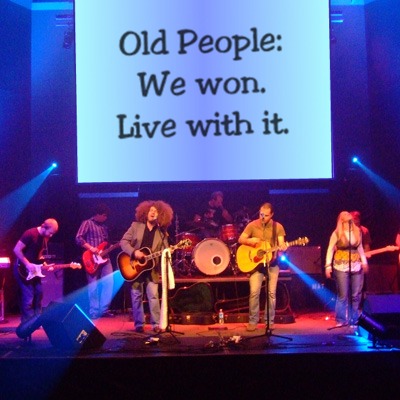
Secret option C in the worship wars, or Worship as flawless performance or communal offering?

worship
Oh my…

One church uses an organ and a choir. Another uses a rock band.

Some churches that had previously used only organ and choir start letting drums and guitars creep in. Perhaps it’s for a song here, a song there. Or we call it “blended,” where a choir leads songs written by Bach, followed by a praise band leading songs written by Chris Tomlin.

Other churches start saying they need to “expand their menu” and offer both. So they start a “contemporary” service.

Still other churches stake their claim with one form and demonize the other, either as “bar music” or “antiquated.”

But what if both options in the worship wars have led us in the same, wrong direction?

I’ve written before about why the worship wars have caused us to focus on style in worship rather than content. Here I’d like to show how they’re about more than just style.

Taken to an unhealthy extreme, the “contemporary” church can strive to put its nearest version of a concert band on stage. Likewise, the “traditional” church may look for the best, classically-trained vocalists and musicians. Both may even hire professional musicians simply for the sake of bolstering the quality of the music performance on Sunday mornings.

And so the question a lot of people are answering in their worship preferences is how they’d prefer to spend a good night out: at a U2 concert or the opera or philharmonic.

When this is our central focus in our worship “offerings,” we equate worship with a performance for people to come and consume. And as the worship wars have worn on, we’ve found “traditional” churches adding more anthems and “contemporary” churches trying to get their bands to sound more and more like the ones on the radio.

All of this conceives of worship in a totally different way than it has been conceived for the better parts of the church’s history.

What is worship? In the best parts of our history, I think we see worship as a gathering of the people of God, coming into the presence of God to offer our praise and thanksgiving, our confession and prayers. It’s a gathering of the people to hear from God and respond. For the Church’s first 1500 years, it was unquestionably a time of coming to the Table to encounter the crucified and resurrected Christ. And it was a time to be sent into the world, bearing the name of our Lord and living by his power and example.

What have the worship wars suggested that worship is? Often, these tell us that worship is a performance. Rather than the people coming to humbly offer themselves in worship, they come to hear a well-rehearsed choir sing to them. Or they hear a rock band sing songs they know from the radio. A friend observed that there’s a difference between worship songs and performance songs. And when our really good bands perform great songs like they’re done on the radio, it makes it pretty hard for a lot of people to sing.

Many will say that this exaggerates everything too much. And they’re probably right. The whole worship service comprises more than that anthem or that rock song. But these are what we’ve leaned harder and harder into the past couple of decades. The traditional churches amplified their “traditional” music by focusing on more choir performance pieces. The contemporary churches amplified their “contemporary” presentation by making it look more like a concert. Both types might do this by relying on professional singers and musicians. If those were the things these churches most amplified in the last few decades, it’s because they saw these — the performance aspects — as the most important piece of what they “offered” in worship.

And so, the problem at root: Churches began conceptualizing worship as what they — the religious service providers — offered the congregation — the religious service consumers. That’s a far cry from worship that we, the people of God, offer up to God.

For some similar thoughts on worship, see “Encounter or Entertainment?”

A tension we need to wrestle with in our worship planning: do we err on the side of flawless performance, offered to the congregation, or communal worship, offered to God?

A few years ago in my community, worship was a two-man show. As the pastor and preacher, I handled any speaking elements. Our worship pastor coordinated a band that handled the musical elements.

In the past several years, we’ve moved (repented?) from that form and become a dozens-of-men-women-and-children show. But it’s not a show; the point is that we’re all participating. There has been a small sacrifice in doing that. The more people you include — especially non-staff people who can’t dedicate the same amount of time to rehearsal/preparation, the more likely it is that something won’t go just right. The worship service may not be flawless. There may be an awkward transition here and there, something not said as well, or as powerfully, as we had hoped. (But then, I make no claims to having led worship anywhere close to flawlessly before.)

For the small sacrifice of including more people, though, I think our worship has become much more authentic. It has become much more fully an offering of what our community has to give of ourselves before God. It doesn’t attempt to limit it to only our most excellent performers. Furthermore, we’ve seen a lot of these new leaders lead various elements of our worship better – with more thought and focus – than was done before.

This doesn’t mean we don’t use some sort of discernment in asking people to lead. For the sake of the person and the community, we try not to put people in places where we haven’t seen that they’re gifted to lead. But as a Body of Christ, we believe everyone has been gifted for something, and we believe it’s neglect of the Body if we don’t make use of those gifts. We might be able to put on a better show if we simply identified the one or two most-skilled people to lead us in each aspect of our worship, but it would be a better show, not better worship.

If the worship wars asked us to focus on which performance style we prefer and formed in us a consciousness of worship as performance, perhaps secret option C is to quit asking questions about performance and start asking questions about what we, as a fully body, can do when we come to worship God. What if we focus more on offering ourselves – all of us – to God in worship and focus less on offering a flawless worship performance to the people?

Some other articles you should read:

Why we chose a church with bad music – (shaungroves.com)
Desperately seeking worship pastors – (Jonathan Powers on Seedbed.com)
What kind of worship service do you have?” (teddyray.com)
Encounter or Entertainment? (teddyray.com)
The Book of Revelation in Summary

rev 22

This fall, we preached through the full book of Revelation in my community. It was a greatly challenging and greatly rewarding book.

We preached through it not because we were trying to figure out which historical figure is the beast, and what the “666” mark would look like. We didn’t pull out timelines and charts. We preached through it because we believe it’s a book for us today. And we found in it great words of comfort from God, and a great challenge from God.

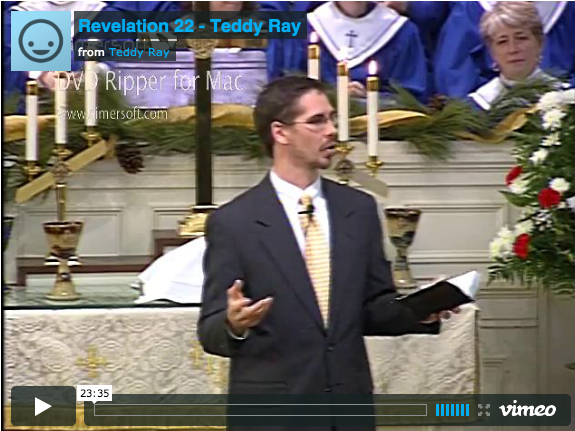
The last chapter – Revelation 22 – serves as a bit of a summary. I thought I’d provide the video for that sermon as a Cliffs’ Notes sort of look at the book, for any of you who are interested. I preached it on December 30.

http://vimeo.com/57941019

5VMEEGA7JVRY

Neill Townsend – 1980-2012

neill townsend

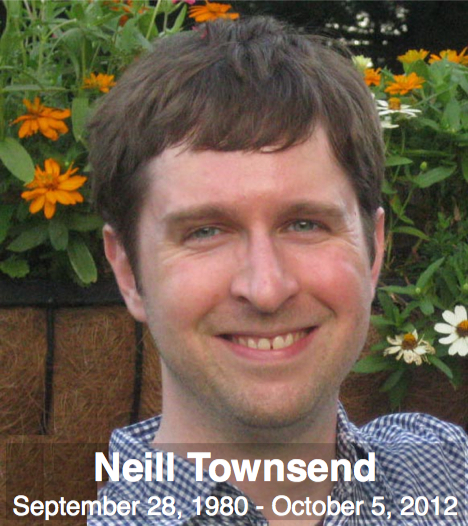
neill townsendToday I had the honor and the dismay to preside at the funeral of Neill Townsend, an old friend. For those who knew Neill but were unable to attend the ceremony, I’m posting my sermon below, in his memory. You can also find Neill’s obituary and leave a note in his guest book here.

Neill Townsend Funeral Sermon – October 12, 2012

I met Neill when we were in preschool. He had those big glasses and that big smile. We went on to 1st and 2nd grade together, where I remember Neill already being heads and shoulders above the rest of us when it came to anything athletic. He was funny and made friends easily. And he was really smart. I can still remember him explaining to me in front of the class why I should know 7 + 5 can’t be 13.  We ended up at separate schools for a few years after 2nd grade.

I didn’t see Neill again until we were in 6th grade. The big glasses were gone, but not much else had changed. He still had that big smile, was starting for the basketball team, the quarterback for the football team, and the star of the academic team. Yes — quarterback for the football team, star of the academic team. And seemingly friends with everyone.

Again, we ended up at different schools after middle school, and I didn’t see Neill for a few years. We actually ended up re-connecting not long after his terrible car accident in high school. That was a hard time, obviously, but also one where I was impressed with how Neill carried himself through it. I still remember him at Aldersgate Camp just about a year after the accident, sharing one night about the incredible change in his life because of the people who had surrounded him and the renewed hope God had given him.

And even in that tough time, Neill still had some bravado. We went on a first date double-date together – on Valentine’s of all days! – and Neill insisted that we take roses. He walked up to the door, put the rose in his back pocket to make it a surprise, and then stepped inside where the door closed and chopped off the head of the rose! He ended up pulling out an empty stem. And yet he came back to the car smiling and shaking his head, and he dated the girl for another year. From big to small, Neill rolled with some of those punches a lot better than most of us do.

At root, it was still the same Neill. Still an excellent athlete, still incredibly smart, still a special knack for making people laugh and smile, still a loyal friend.

I hadn’t been in touch with Neill since high school, but it wasn’t surprising to hear the more recent stories as I talked with Lee, Jane, and Scott this week:

  • Stories about a workplace that saw him come in and quietly do his job, and before they knew it, he seemed to have his hands in everything. They’ve been talking about how many people they’ll need to hire to replace him now.
  • Stories about Neill asking his mom to put him on speaker phone so he can talk to the dog
  • Stories about friends that Neill had reached out to and been a steady presence in difficult times

I think Scott said it best the other day. A number of different people have been calling, writing, visiting, and sharing about Neill. Scott said some of the stories were new, but none of it was news. He said, “We just keep getting confirmation that everyone knew the Neill we knew. The same Neill we’ve known all his life.”

And though we all knew the same Neill, it’s also amazing how many different sides there seemed to be:

  • The athlete and the avid reader.
  • The person who could so easily make a crowd laugh and the person who went out of his way to give special attention to friends going through tough times.
  • The passionate sports fan and the passionate advocate for justice, all the way from Appalachia to international war crimes victims

We gather this morning to thank God for blessing us with Neill in all of his wonderful diversity.

At the same time, as much as there is to celebrate about Neill’s life, we can’t believe we’re here.

Several of us have had the same thoughts this morning as we came here. We’ve had the same thoughts throughout this week. “It just doesn’t seem real. Doesn’t seem believable that we would be preparing for Neill’s funeral.”

In the reading from John, we just heard Jesus say, “Let not your hearts be troubled,” and, “Peace I leave with you.” Now I doubt most of us could honestly say our hearts haven’t been troubled this week. It would be difficult to say we have had a real peace throughout. And that’s okay. In the Bible, we even find Jesus weeping at the tomb of his friend Lazarus.

But I’m comforted to know that even in the face of a terrible loss like this, the words of Jesus are still, “Let not your hearts be troubled… Because I live, you also will live.” This is the hope I know and rely on in times like this.

In Jesus Christ, we see the promise of life, even where the world may see only death. In Jesus, we see that God sent his only Son to walk this earth and to endure even death, so when we come to times like this, we know that God is not a distant God, unable to understand or empathize with our pain.

And in Jesus, we see a triumph over the grave and over the forces of evil. When Jesus said, “Because I live, you also will live,” he told us that death does not have the last word. And when he died and rose again, he proved that word true. This is why he says, “I am the resurrection and the life. The one who believes in me will live, even though they die; and whoever lives by believing in me will never die.”

We sang “Great is Thy Faithfulness” earlier. We heard Jesus say, “You trust God, trust also in me.” We believe that God’s compassions do not fail, that God gives strength for today and bright hope for tomorrow, that He is a faithful God.

If you come here today with deep pain, the best thing I know to do is point you to the God who says, “Comfort, comfort, my people.” If you come with sorrow and distress, I pray you find hope in Christ who says, “My peace I leave with you.” Though we mourn now and have every reason to, I trust a God who says that in time he will turn our mourning into gladness; he will give us comfort and joy instead of sorrow.

With that hope, we come now and entrust Neill to God, who can be trusted.