
“Keeping the lights on” vs “Giving to missions”

lights on

lights onIt’s a lot more fun to give to missions than giving to keep the lights on. I hear that a lot in my position.

And I get it. It really is more fun to think about all the great work being done by [fill in your favorite outreach center / missions agency] than to think about paying the church’s utility bills.

But do you know what almost every outreach center / missions agency has to do when they receive that money? They pay to keep their lights on.

Is there a better way to think about our giving? Can we acknowledge that all those mundane things – like keeping lights on – are an important part of the extraordinary ministry happening in any setting?

Perhaps we shouldn’t be so quick to ask whether we want to pay to keep lights on or to pay for something that sounds more glamorous. I wonder if I’ve ever been a bit selfish in wanting my giving to go only to the actual work – not to mundane things like lights and administration. It’s as if I thought, “Someone else’s money can pay for the mundane, I want to feel like my giving went to something special.” And at that point, it’s really about me, isn’t it?

We’re well-intentioned in this, please don’t get me wrong. But do you think we’ve taken an approach that isn’t really fair or best?

Is the charitable organization you’re giving to being wise and faithful with money? Do you believe in their mission? Do you believe in their faithfulness to that mission? Then give generously to them, knowing that part of what they’ll do is pay the utilities bills.

Is the charitable organization you’re giving to being wasteful? Are they choosing luxury and extravagance to the detriment of the mission? Has bureaucracy overtaken mission? You’ve seen some questions I’ve raised about salaries and buildings. Then you should probably talk to them about it or stop giving. I’d strongly recommend talking first. There’s a chance you don’t have the full picture.

If you’re giving to a church, I think it’s important to ask how much that church is giving beyond itself. How much is going purely to provide care and activities for its own? How much is the church actively sending out to support other outreach centers and missions agencies, to support the extended proclamation of the gospel across the world?

I’ve been really proud to see my church trying to take next steps toward this. Just last night, our Council affirmed a decision to immediately send 25% of all giving out the door – 10% to support outreach and missions, 15% to our denomination. We hope to do more, but I’m happy with the movement in this direction.

Where I’ve come to in it all… If I believe a church/center/agency is doing something good, I want to give to them freely. Yes, some of that will go to keeping the lights on. But I’m glad they have the lights on so they can keep doing the extraordinary work they’re doing. I don’t want to hamstring them by requiring my money to go for something extraordinary and telling them to find someone else to keep their lights on.
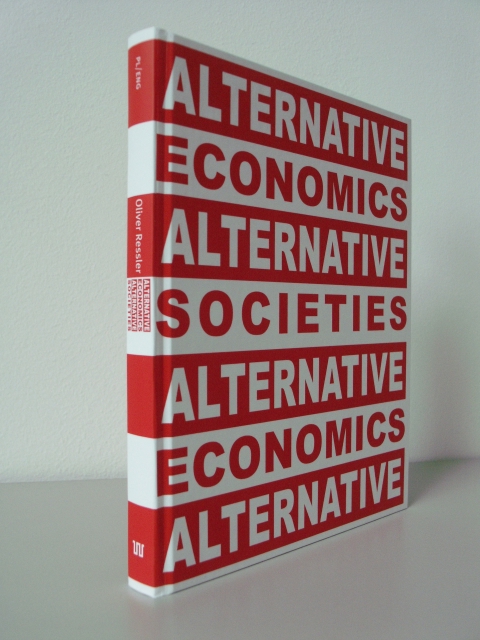
The Church as Alternate Economy

alternate economy

alternate economy* This began as a response to a good comment on The Pastor Salary Fallacy. See comments there for points to the other side.

Let me take a first stab at describing why I speak about the Church and money in ways that sound odd to most people.

The Church as Alternate Society and Alternate Economy

At root, I’m looking for the Church to live as an alternate society (by no means separate from the world, but by all means very distinct from the world), a society that in many ways provides a prophetic critique of the rest of society, a counter-culture. This is some of what I was getting at in the post Prophets and Pragmatism.

And in a culture submerged in capitalism (no, I don’t believe God is a capitalist… or a socialist – see Christians, Capitalism and Ayn Rand and Jesus and Politics), I think one of the most important parts of that alternate society is an alternate economy.

Though maybe our capitalist-immersed setting doesn’t matter. Scripture always seems to describe an alternate economy. One that would have been shocking and rubbed right against the grain of the rest of the world’s economy.

Church Use of Money

So when we consider the Church’s use of money, at best I hope our use of money will be a prophetic critique of the marketplace. At worst, I hope it will ignore the marketplace. Whatever we do, I hope our use of money won’t be overly influenced by the marketplace. Can we re-imagine how money would be handled in a new creation economy without being terribly influenced by the capitalist US marketplace?

For instance – why are we concerned to be sure our high-level people have enough for comfortable retirement, a nice house in a good school district with nice vacations, but we don’t seem nearly so concerned for the same with our custodians and secretaries? I get why the capitalist marketplace differentiates these, but why the Church? What does this reflect about a new creation, Christian economy? We usually say something about “fair,” but what’s our standard for fair? Is the standard “fair market value”? And here we are again, back at capitalist economics in the Church…

This is just something early to try and identify the issue at root in our differences. I need to spend more time thinking and writing on this. Perhaps it will help me realize the fallacy of my own thinking. Perhaps it will convert someone else to my position. (Then there will be four in the world!) Most likely, we’ll all just keep talking in different directions. But at least we’re all trying and talking.

And an important note: this is hard and requires plenty of discerning and questioning. “Do not steal” is usually pretty easy. We can generally draw an easy line with “Do not commit adultery.” On issues of how to live out an alternate economy in the Church, the answers aren’t nearly so clean. I don’t presume to have them all, or to be doing it all even close to right. But regardless, I think they’re important questions to ask and attempt to answer with our lives.

For now, some links to those who have been most influential for me in all of this: William T Cavanaugh, James KA Smith, and John Wesley.

“Your organizational structures are killing you”

decision making

decision makingI was recently talking with my good friend Eddie, part of the leadership team at a mega-church, and I asked, “What’s a blind spot smaller churches seem to have – from the vantage point of mega-church world?”

Eddie didn’t even hesitate. “Your organizational structures are killing you,” he said.

Me: “What does that mean? How can we organize differently?”

Eddie: “Last year, we had the idea to start a multi-site location one Tuesday. It was the first time we had ever talked about it. Six weeks later, on Easter Sunday, we opened the site. How many committees would your church have had to go through to do that? How many people would have had to approve it? How long would it have taken you?”

At Eddie’s mega-church, there’s a weekly Tuesday meeting of their 6 or 7 primary leaders. He says everything could change on any given Tuesday.

Now we’re not all trying to become mega-churches. That’s not what I’m advocating here. And maybe we would say there are good reasons to move a bit more slowly. But is there a chance your organizational structures are a serious problem? How long does it take to make a relatively major decision? How many meetings have to be called?

How long to make even a minor decision? Are there less-than-earth-shattering things that likely can’t be accomplished in three months’ time because there are too many steps in the decision-making process to get there by then?

[For an example of how the UMC is struggling with this at an Annual Conference level, not to even mention the General Conference level, see here.]

How come a 3,000-member church is able to turn more quickly than churches much smaller? This seems to defeat the whole notion/excuse that “It takes an aircraft carrier a long time to turn around.”

And is there a risk that church politics start to play a bigger role when people know how easy it is to throw a wrench into the middle of plans and grind everything to a halt – or at least slow it enough that it’s likely to die?

Invite some friends to join the conversation –
share this on Facebook.
Thanks!

For anyone in church leadership, you should take the time to read the article “Leadership and Church Dynamics,” by Tim Keller. Thanks to Chad Brooks for pointing it out to me. Find the link here (requires free registration) or download the PDF directly here.