 “Missional church” has been a big movement and buzz word in recent years. The thrust of the movement is to recall the Church’s identity as a sent community, one that reaches out to those around them. It serves as a critique of the “attractional church” that attempts to attract people with great product offerings and marketing. (Less corporate words may be used, but the idea is the same.) Want a helpful 2-minute video primer on “missional church”? Try this.
I’ll start with this. I think the missional church’s critique of the attractional mindset is good and needed. See my posts, “Attracting with Buildings” and “Offer the Gospel!” And I think the missional church folk have generally had a good message for us: the church must get outside the walls of its own buildings and its programs for members.
But I’m also concerned that some of those influenced by missional church ideas have gone too far and are misunderstanding the church. An example comes in this blog post that was just sent to me. The post is actually very good. A helpful assessment with some great points. You should read it. But this statement in it made me cringe:
Theologically, I’m convinced that the Church is in the business of putting itself out of business. The mission of the Church, after all, is not the Church but the coming reign of God (emphasis mine).
This statement comes from an understanding of the Church that has an entirely outward focus. It calls on the Church to go into the world in outreach and witness until no more outreach and witness are necessary. If those goals were accomplished, the author reasons, there would no longer be a need for the Church.
Some use this mindset to say that the Church can and should bring the kingdom of God on earth by ridding the earth of all social evils. We’ve seen that before. In one of its most popular and recent manifestations, it was called the Social Gospel movement.
Others have rightly said that the kingdom of God and the defeat of evil will only come at Christ’s return. Still, they have argued that the Church’s sole purpose should be to work toward those goals. Even if we can’t “put ourselves out of business,” we should still work as if that’s the goal.
But for the Church to try and put itself out of business tragically misunderstands the nature of the Church. This kind of understanding assumes that the Church’s only calling is outward in witness and outreach. That understanding forgets that the Church is the bride of Christ, that Christ loved the Church and gave himself up for her (see Ephesians 5:22-33). That understanding likely assumes that corporate worship is only for equipping people to go back out into the world in mission. It would see the only purpose of Christian fellowship as a form of preparation for the mission.
This article by John MacArthur – “Inward, Upward, or Outward?” – illustrates that mindset well.* I saw the article’s title and thought someone else was making my point. Instead, I found MacArthur proving the problem. In the article, he makes it clear that the Church’s “inward” and “upward” activities are fine and good, but the Church’s real purpose is “outward.” His concluding words:
Fellowship, teaching, and praise are not the mission of the church but are rather the preparation of the church to fulfill its mission of winning the lost. And just as in athletics, training should never be confused with or substituted for actually competing in the game, which is the reason for all the training.
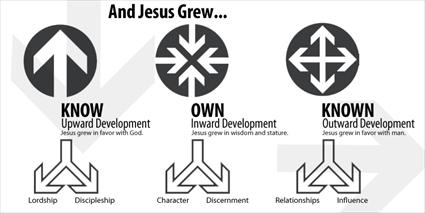
I think MacArthur is totally wrong. I was excited to see his title, thinking he was going to argue that the central calling of the Church is inward, outward, and upward. They can’t be teased apart. One can’t be favored. And all three are essential. I was disappointed to find him making the opposite point.
Fellowship, teaching, and praise are not training – they are the very being of the Church! If we call our worship, our fellowship, our prayer, our sharing in communion, and our study of Scripture simply training, we take the typical pragmatic, man-centered turn that seems to plague most of the American Church’s thinking today. We make all of these into pragmatic steps toward accomplishing the mission and miss the deeper point of these actions.
The Westminster Catechism famously asks, “What is the chief end of man?” and famously answers, “To glorify God, and to enjoy him forever.” In all, I’m concerned that some influenced by the “missional church” movement have a new response to that question. They want to answer that the chief end of man is to glorify God by outreach and witness. All else is just training.
Why do we worship? Not primarily to be equipped for mission, but primarily because we are the people of God.
The central purpose of our worship is to worship God – to praise and enjoy him. And that’s enough! I hope it prepares us for mission, but that’s a secondary purpose.
The central purpose of our prayer is to pray to God. And that’s enough!
The central purpose of our fellowship is to share deeply with each other as the Body of Christ. And that’s enough!
And the central purpose of our outreach and witness? To show compassion, to fight for justice, to advocate for the oppressed, and to testify to the gospel. And that’s enough!
All of these works are an end unto themselves. They don’t need to lead to another point. They are the point. Or if we insist, we may say they all lead to glorifying and enjoying God. But let’s make sure we keep that as the chief end of man and the Church — inward, upward, and outward. The business of the Church isn’t to put itself out of business. It’s to glorify and enjoy God, to be prepared as a radiant bride for Christ, to live in fellowship and mission as the body of Christ.
For more, SUBSCRIBE for e-mail updates.
————
* Note: MacArthur is no figurehead for the “missional church” movement. But I find his statement here reflective of the mentality that I see sometimes coming from that movement.


 Well this is just brilliant:
 Discipleship is often treated today as an end in itself. And to a certain extent, I’ll agree with that. When we worship, pray, study Scripture, fast, do works of mercy and works of piety, etc., these activities are the point. They’re means of God’s grace and ways we honor God, so we do them.
 teddy ray