The People Don’t Perish Without a Vision Statement

no vision
no vision
Yes, the reference is wrong. It should be Prov. 29:18

You’ve probably heard the line before: “Where there is no vision, the people perish.”

You’re most likely to have heard it in some sort of church planning meeting. Or in a ramp-up for the unveiling of a new, great church plan. There’s likely a capital campaign at hand, too.

“Why does our church need a vision statement? Because without it, the people perish. So says Proverbs 29:18.”

I’ve heard this proverb quoted dozens of times to prove that the church needs to be involved in strategic planning, mission statements, vision statements, core values, etc. And it’s always quoted in the old King James Version. Even hip, Message-Bible-using contemporary pastors resort to the KJV for Proverbs 29:18.

Why? Because here’s how the NIV reads: “Where there is no revelation, people cast off restraint.” Or try Today’s English Version: “A nation without God’s guidance is a nation without order.”

What the Proverb is About

This is a proverb about receiving guidance from God.

This is about a people’s desperate need to hear from God.

It’s about the ways that people go off and do whatever they feel like doing if they don’t heed God’s instruction.

What the Proverb is NOT About

This is not about crafting “our vision.”

Google “church vision statement” and you’ll see all kinds of advice about making big plans, dreaming big dreams, and inspiring your people. These may frequently include the types of buildings and land a church will own, the types of programs they will offer, and the types of people they will attract.

Yes, most good leaders and churches will surely at some point mention that the vision is “inspired by God.” But does the process really always reflect that? Are we more frequently asking what our plans, hopes, and dreams are, or asking for a revelation from God?

A godly vision

My point here isn’t to tell you to drop all the strategic planning. I think it has its place. We do need to know what we’re aiming at.

Actually, I think the bigger problem is that churches today are having to create vision and mission statements. Do we really not know what we have been put here to do?

Somehow, it seems that churches got sucked in by the visioneering of the ’80s. We’ve all been taught that if we don’t have a mission statement that every member has memorized and a vision statement that has captured the congregation’s imagination, we clearly have no idea what we’re doing. Let’s just remember that the Church survived (and at many times thrived) for nearly 2000 years without these things. The great business strategies introduced a few decades ago probably aren’t what the American Church is looking for to end its decline.

Is it possible that all of our visioneering is actually preventing us from more clearly hearing from God? Is it possible that we’re missing something bigger because we’re so set on our vision of becoming a mega-church, or our strategic action plan to build a gym?

A disclaimer before the comments:do think strategic planning has its place. I have no great fondness for formal mission statements. The church (and even businesses) found some way to survive all the way to the 1980’s without these now-imperative statements. But I don’t think they’re inherently bad. I’m just wondering if we’ve given strategic planning too much prominence. If we’ve made this more about (wo)man-centered vision than a revelation from God. Is that why we insist on going back to that comfortable KJV version of Prov 29:18 to make a point that the proverb isn’t making?

What do you think? Share something in the comments.

Multi-site church, localized ministry

multisite

multisiteAt First UMC of Lexington, KY, where I’m executive pastor, we’re doing something that is becoming quite common in the North American Church — we’ve gone to multiple sites and multiple worshiping communities.

At the same time, we’re doing something very unique, at least from what I have seen as I survey the landscape — we are localizing nearly all of our ministry and mission. This is not a hub-and-spoke sort of model, where one site is the “mother church” with several “daughters.” That’s different from the typical central planning we usually see in multi-site churches, and it’s a very intentional difference.

We’ve begun to see the great opportunities this structure provides. I’m posting below an article that I recently wrote for our church community. I hope you’ll see some of my excitement for what this structure allows. We currently have three communities: Andover, Downtown, and Offerings. I’ve made it no secret that I hope we have at least two more in the next five years.

I’d love to hear your thoughts and questions. There’s plenty more behind all of this, and I hope to share more of it soon.

—————–

One Church, Multiple Communities

“What does it mean that we are one church and multiple communities?”

“Why wouldn’t Andover be its own church since they are 8 miles away from our downtown campus?”

“Can we really be one church when we don’t all see each other regularly?”

If you have been around First UMC for long, you’ve probably had some of these questions. I think we all have. Our church is doing something unique, so it’s no surprise that we have all had some questions and confusion along the way.

In the coming months, I’m planning to write a few articles about our structure that might help all of us get a better understanding of how First UMC is organized. More importantly, I hope to show the mission behind why we are organized the way we are.

We are a multi-site church. That’s a relatively new concept. In 1990, there were only 10 multi-site churches in the US. By 1998, there were only 100. By 2005, shortly before we opened our Andover campus, there were 1,500 multi-site churches.

Why multi-site? You may have heard Pastor Mike talk about First UMC’s mission: to make disciples across the street and around the world. That value of making disciples “across the street” takes seriously the importance of being where people are. The Methodist Church has always been serious about that. Until the year 2000, the UMC had a church in every county of the US!

To make more disciples, to reach more people for Christ, we believe it’s important to be across more streets. In the history of the Church, the best way to reach new people has consistently been to open new places of worship. We’ve seen the great value in that at Andover. Our church is reaching people in that community that we never would have reached if we had remained only downtown. I hope you’ve heard Todd tell some of the stories about families who have come back to the Church and people who have been baptized into the faith because of the new Andover congregation.

We’ve also learned that we can do some things better together than we can apart. Why hasn’t Andover become its own, independent church? Because we believe we’re better together. Mike, Todd, and I spend time together weekly to offer each other support, encouragement, and direction in the way each of our communities is going. We have a financial team that is able to handle the church’s finances much better and with less cost than if Andover, Downtown and Offerings each tried to handle finances separately. On high days of worship like Pentecost, we are able to draw on the gifts of people from all of our communities. And should we consider starting a fourth worshiping community – getting across another street to reach more new people – we believe that we can do that better together, too.

We are a very different multi-site church. Yes, there are over 1,500 multi-site churches in the US, but as far as we know, there is only one multi-site church doing what we’re doing! The typical multi-site church beams in a video of one pastor preaching to all of the sites. Or if not, all of the preachers preach the same sermon in their own setting. They have the same announcements at each site. They essentially offer worship site alternatives and keep everything else together. That’s very different from what we’re doing.

Each of First UMC’s worshiping communities has quite a bit of freedom in its worship, its preaching, its discipleship, and its outreach. That has been a very intentional, much-discussed decision. We have decided to be one church with multiple expressions. 

We believe there are a number of good ways to worship and become disciples, and we want to allow each community to embrace the forms that are best for them. We all have the same Wesleyan theology. We all believe in the importance of worship, growth in small group community, and service in the world. We all believe in making disciples. But we each embody those values differently.

Why are we one church? Because we believe we are better together. Because we all share the mission of making disciples. Because we want to maintain a connection of encouragement and ideas, even if we aren’t in the same building on a regular basis.

Why are we many communities? Because we believe we can make more disciples by being across more streets. Because we believe we reach more people through multiple expressions. Because we believe we can become stronger disciples when each community has the freedom to handle worship, discipleship, and outreach just a bit differently.

We have created a structure very different from most you may have seen. That inevitably creates questions and confusion. It has been a learning process for all of us. But I have a great excitement about the possibilities for First UMC’s future. I truly believe our willingness to try new things is preparing us to do great new things in Lexington and around the world. All of this only by the grace and power of God. To God be the Glory!

Grace to you and peace,
Teddy Ray
Executive Pastor

More to come. Why don’t you subscribe for e-mail updates?

Prophets and Pragmatism

zechariah stoned

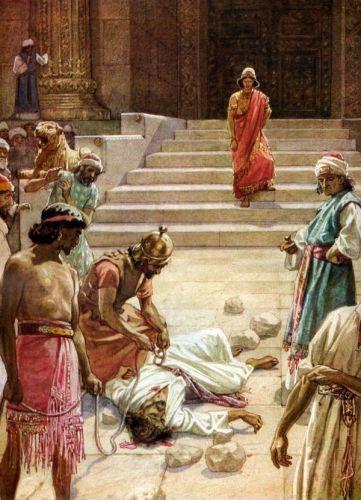
zechariah stonedWhat if we judged the prophets of the Bible based on their results?

Most would be considered miserable failures.

The Prophets

The general story goes like this. The prophets’ were sent to a people who had rebelled against God. The people had committed idolatry or neglected and oppressed the poor. Usually both. And the prophets told them that destruction was coming if they didn’t repent. The response? The people scoffed at them. In several cases, they killed them (see 2 Chronicles 24:20-22, 36:15-16, or Jeremiah 26:20-23 for some examples). Then the people went back to their idolatry and oppression and neglect of the poor.

Pragmatists today would look at the prophets and say they wasted a lot of time. Or had bad strategies.

Perhaps they should have spent more time working on PR and networking. Maybe they should have had a gentler approach. If they hadn’t burned so many bridges (and gotten killed) for speaking up so strongly, they might have been able to achieve a bit more progress over time—maybe not a full turn from idolatry, but at least a few Asherah poles cut down.

The Pragmatist

The consistent cry of the pragmatist is to only do what works. And (though it’s rarely stated outright) to be willing to compromise the real message and impulse of Christianity just enough to make it acceptable in our culture.

That music director who’s a terror to others, but who draws a large crowd each Sunday? Let’s not do anything too drastic. People may be coming to Christ through her work.

The biggest giver in the church is having an inappropriate extramarital relationship? Let’s not confront this too directly and face losing him. Just think of all the ministry that’s taking place because of his giving.

No, a new creation economy surely wouldn’t have our top-level people being compensated at five times the lowest-paid. But that’s the way it works, and we’re not going to be able to change it.

There may be a general question about compromising a bit of holiness to gain the appearance of more relevance.

You get the picture…

The Difference between the Prophet and the Pragmatist

At root, there is a single difference between the prophet and the pragmatist. They have different goals.

And both of their goals are good goals. But I believe one is far better.

The goal of the prophet: be faithful to God. The prophet is sent by God to address sin, injustice, and heresy, wherever they may be found. Now certainly there’s some discretion about how to do this. Look at the various methods of the prophets. Isaiah walked around Israel naked and barefoot for three years (Isa 20:3). Hosea married a prostitute. There are times that they hide and wait and other times that they go boldly. But the message of God is never compromised, even if they may have achieved better results otherwise.

The goal of the pragmatist Christian: achieve results for God. The pragmatist really does want to achieve these results for God. I don’t question that. His intentions are good. But in the process, he is willing to make [what he considers] small compromises for the sake of results.

While I believe both prophet and pragmatist aim at something good, I believe the prophet’s goal is far better and more appropriate. Paul said, “Neither the one who plants nor the one who waters is anything, but only God, who makes things grow” (1 Cor 3:7).

We don’t make things grow! God does. We plant and water. And I think it’s best that we plant and water with only the purest seed and purest water. We faithfully do as God calls and leave the results to God. Anything else confuses our role in the process.

So to put it plainly, I believe full faithfulness to God is more important than anything else. Even than evangelizing and converting more people. Even than eliminating more injustice. Even than preserving the church for its future work.

Ask a pragmatist, and it will be hard for them to say the prophets were “successful.” At the least, they’ll have to skew their definition of success for the prophet, then refuse to hold that some definition for their own work. Oddly, the most successful prophet, by pragmatic standards, was probably the least faithful of all the prophets: Jonah. Whatever it presents, I don’t think the account of Jonah is trying to persuade us to be like him.

The questions that will come

Some valid questions will come back, and I don’t want to take the space to answer them now. Perhaps later or in the comments. The challenges and questions I expect:

– “Great. Make it all about faithfulness to God and not results. Sounds like an easy way out when you don’t achieve any results.”

– “The prophets were sent by a clear word from God. You can hold to their standards when you hear an audible word from God as clearly as they did.”

– “Paul became all things to all people so that by all possible means he might save some. Sure sounds pragmatic to me…”

These are all legitimate. “Faithfulness to God” has been used for all sorts of laziness, personal agendas, and outright evils throughout history. What I’m trying to combat is perhaps a bit more plain – those situations where someone says, “Well that’s true/right/better, but it just won’t produce results.”