Buzz vs. substance

fraudIn a totally different segment of my life, I’m a partner in a new coffee and donut shop in Lexington. We’ve been open just over six months. In the past couple months, sales have started taking off.

We had one particular Saturday when sales crushed all previous highs. I texted a partner who manages the store, “What in the world happened today?” There must have been a $500 order, I figured. Or some big news story about us had run, and I didn’t know about it. Or they ran a promotion that I wasn’t aware of.

His response: “We make really good coffee and donuts.” (It’s true. They’re really good. You should come try if you’re anywhere near Lexington.)

His was the perfect response. Our total advertising budget so far has been $200 — the cost of two banners to hang outside the store. From the beginning, making good donuts and coffee and providing a friendly face at the counter has been the primary focus. And thanks to social media, perhaps now more than ever, if you give people good substance, they’ll create the buzz for you. I’ve come to love searching for the shop on Twitter to see what people are telling their friends about us.

Now for what it’s worth, at least in my opinion, it does have a pretty good atmosphere. And we have done a lot to invite people. It’s not like we just made good donuts in a decrepit building and hoped people would show up. A nice atmosphere is important. Inviting people is crucially important. But a quick look at the reviews shows what’s of most importance — “Are they selling something good?”

Yes, some self-promotion there, but nearly all of our early success is my partners’ doing, so I don’t feel too bad giving us a public pat on the back.

Buzz

A friend told me this weekend about an opposite experience. A new brewery opened where he lives about a year ago. He explained that the owners had started with a ton of money and not much brewery knowledge. They invested the majority of their time, energy and money into creating an exciting atmosphere and a lot of buzz.

“For the first three months,” he said, “it was the hottest place in town. Everyone had heard about it. They were waiting for it. And the whole place just looked impressive. You had to go. But there was a problem…

“The beer was terrible. Really. Terrible. They spent all their time and money creating a cool place, but you can only live on that for so long.”

He went on to explain that they sought help (fortunately for them, they had a lot of money — a rich uncle or something), got better with the beer, and survived, but not after going dead and nearly having to close.

Buzz vs. Substance

Most of us only have enough energy and money to do one well. You can create a big buzz, or you can work on having great substance. Would it be good to have a little of both? Of course! But only a very few can invest big-time in both.

Invest in buzz, and you can turn out a big crowd initially. But how long will it last before they realize the sizzle was better than the steak? Given the advent of social media and today’s increase in options, frauds can get exposed and abandoned quickly.

Invest in substance, and the growth curve may be slower initially, but I believe you have good reason to expect increasing momentum.

This gets at some of what I was suggesting in “The Christian Bubble.” Beware of focusing more on buzz (i.e. exciting programs, events, and spectacles) than substance (i.e. Offer the Gospel! and make disciples that become apostles and pastors). All the way back in the 1930’s, Deitrich Bonhoeffer was pointing toward this as a major problem in Germany. It looked a bit different, but I think it was the same issue at root.

In some of our situations, the “buzz” may last for more than a few months — perhaps several years or even decades. But eventually, when substance is lacking, the fraud gets exposed.

On the other hand, focus on substance, and the initial build may be slow. But I hope it gives us opportunity to ask, in the middle of a great movement of faith across the land, “What in the world is happening?” and to hear in return, “We make really good disciples (who make disciples, who make disciples…)”

And of course, a real movement of that sort comes only with the movement of the Spirit. We plant seeds. God makes them grow. Are we invested in planting good seeds?


Being fed

I posted this nearly a year ago. I’m re-blogging myself (is that okay? probably not). And yet I’m doing it anyways, because:

a) I don’t even think my wife was reading when I posted this. So it’s new content for all but three of you out there.

b) I’ve realized how much I’ve written since that is trying to do the same thing — combat the notion of church and Christianity as a consumer spectacle, and instead encourage us to see Christianity – and our participation in the church – as a participation in the life of God. When we come to the faith and the church as selfish consumers, I think we’ll come away empty in the long run. That means church leaders need to be doing anything we can to help people participate in the life of Christ, not just come and consume a good show/program/event/service. That makes it messier. But it’s also real food.

Teddy Ray's avatarteddy ray

feed me“My food,” said Jesus, “is to do the will of him who sent me and to finish his work.” John 4:34

“I’m just not being fed.” You’ve heard the cliché. It tends to mean that someone isn’t hearing things that are comforting, challenging, enlightening, or motivating. Or perhaps that they aren’t enjoying something enough. At its base, it expects a passive reception of something that a church leader or church program should be providing.

What if “our food” were the food Jesus speaks of? If our food, like Jesus’, is to do the will of the Father, “being fed” ceases to be a passive reception and becomes an active involvement in God’s mission. It transforms our understanding of Christianity from a focus on prosperity (“What am I getting?”) to a focus on participation in the will of God (“How am I participating?”).

View original post

Liberal and Conservative theologizing — a caricature using song lyrics

mirrorIn my last post, I introduced language about theological liberalism and conservatism, and I got the sense that I needed to give more definition.

Some notes about what I mean by “liberal” and “conservative”

Most people conflate the theological divide with political ideologies, but they’re almost entirely separate ideas. You can be politically liberal and theologically conservative, and vice versa (although I expect the majority are actually conservative in both or liberal in both, for reasons I won’t get into here…)

So the way that I’m using “liberal” and “conservative” isn’t intended to address politics. In fact, even within the Church, I gather that there are different definitions. I’m using these the way I primarily see and experience them in Protestant-world.

Regarding conservatives, I’m really referring to fundamentalist theology here. I’m dealing with any sense of the Bible being inerrant as typically understood, which is often listed as a core tenet of conservatism.

Here’s a simple attempt to present these different theological methods.

Disclaimer 1: This is, admittedly, quite caricatured and limited. I do this to highlight starkly and basically the differences in these methods. If you want all the nuance behind these, I’d suggest Nancey Murphy’s Beyond Liberalism and Fundamentalism (affiliate link) as a good start.

Disclaimer 2: I’m using a song lyric, which is not Scripture. So all analogies can’t hold. But enough can to paint a starting picture.

Let’s imagine we found the lyrics of the brilliant Fleetwood Mac song “Landslide” in the Bible:

I took my love and I took it down
I climbed a mountain and I turned around

And I saw my reflection in the snow covered hills
‘Till the landslide brought me down

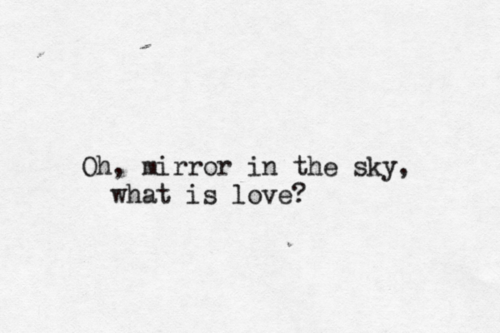
Oh, mirror in the sky
What is love?
Can the child within my heart rise above?
Can I sail thru the changing ocean tides?
Can I handle the seasons of my life?

How would liberals and conservatives each read this?

The conservative reading

The conservatives would say that the writer must have climbed a mountain, then turned around. And just as she saw her reflection in the snow covered hills, a landslide – probably caused by God – brought her down. Now, since mountain climbing didn’t work out, she should consider sailing, but that could prove an obstacle, too.

The conservative might begin to conjecture about why God brought this avalanche at just such a time. God must have wanted to put her in a better place. Or perhaps climbing the mountain in the first place – or gazing in the snow for too long – was a sin, and the landslide was punishment.

Prove to the conservative that the singer has never actually climbed a mountain or encountered a landslide, and their faith will be seriously shaken.

The liberal reading

The liberal reads this and knows that it’s unlikely for someone to survive a landslide on a mountain. They begin to reconstruct the real history of this account: the author was probably so focused on looking at her own reflection in the snow that she slipped and tumbled. To her, it felt like a landslide. But we know better.

Indeed, much modern psychology shows that when someone becomes obsessive about a love interest, she can lose all sense of reality. This can cause both the dizzied state that caused the author to fall, and the irrational state that caused her to blame her fall on a “landslide.” The song reveals the experience of all humanity and confirms our modern psychological findings.

Problems

It’s not too difficult to see the problems in both of these caricatures. Oddly, both remain focused on what was actually happening in the historical account. One accepts the historical account as inerrantly true. The other seeks to reconstruct the “true history” and the real, universally applicable human experience. One presupposes that God was active in the historical account, and acting literally as presented. The other presupposes that God’s direct involvement isn’t really necessary.

You could say that simple attention to genre would help solve these problems. And you’d be at least mostly correct. Do you see how our inattention to different genres in Scripture has caused problems? And especially how it causes problems to ignore all of the Bible as first a theological document rooted in history? But genre confusion isn’t the only problem here.

You see, at heart, both of these expect that language is descriptive — either to describe objective historical reality or to describe subjective human experience. But what if neither is really the case? Many would say that the Enlightenment – with all of its science and rationalism – convinced us to start thinking about theology and reading Scripture in a different way than we should. The assumption of modern thought forced people into two camps — relying either on the Bible or human experience as their ultimate foundation. Anything that contradicted that foundation would need to be explained away or outright refuted.

But what if there are other options? Some lead down similarly bad roads. But I think others help us think about God and read Scripture in a much more helpful way. More on that later…

To get more, you should JOIN my e-mail update list.